Continuity Global Awarded $10M Air Force Deal for Misawa Base in Japan

Continuity Global Awarded $10M Air Force Deal for Misawa Base in Japan

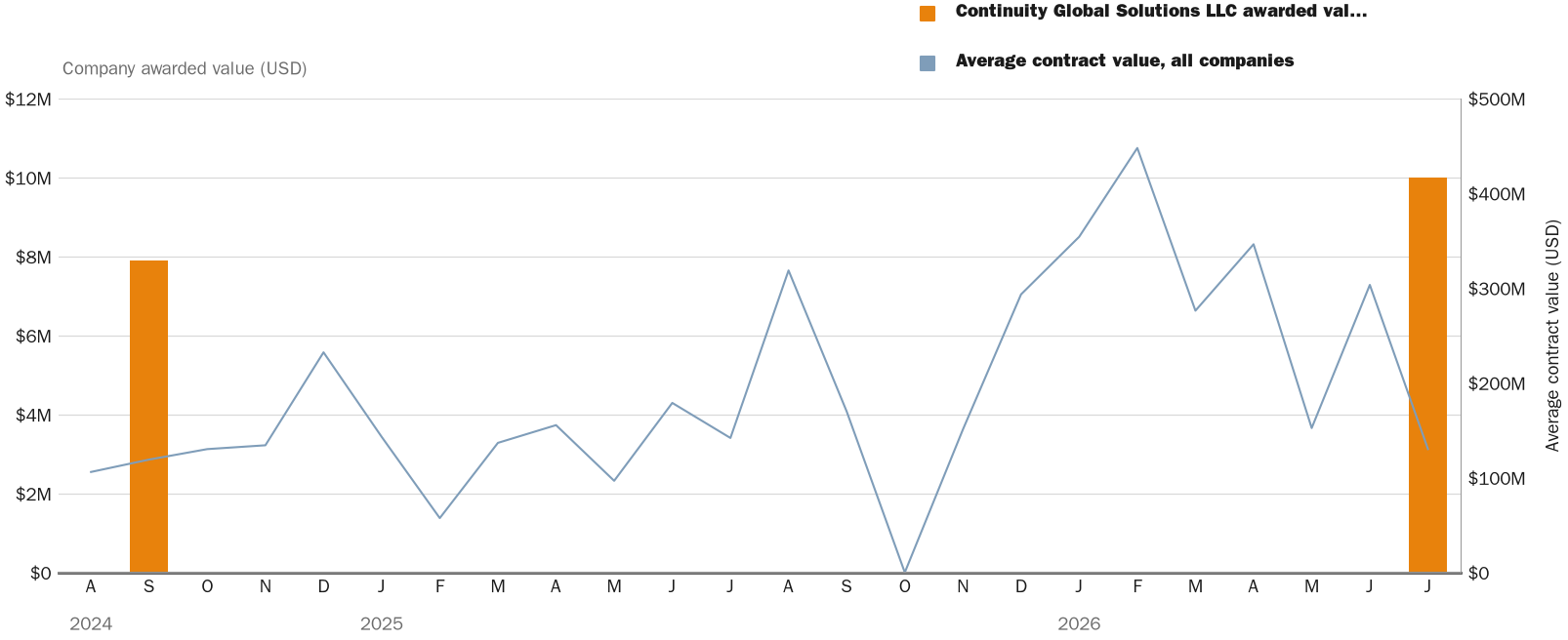
Continuity Global Solutions LLC secured a ceiling $10 million contract for information protection services at Misawa Air Base, Japan, with work due by Aug. 31, 2031.

Richard Miniter
First Published: July 10, 2026, 2:32 PM ET

— LEDE Continuity Global Solutions LLC, a St. Joe, Florida, contractor, won a ceiling $10 million Air Force deal for information protection services at Misawa Air Base in northern Japan, the Department of War said on July 10, 2026 at 5:00 PM ET.

NARRATIVE The award is an indefinite-delivery/indefinite-quantity contract, a structure that caps spending while letting the government order services as needed. The contract covers information protection services tied to building construction. The 35th Contracting Squadron at Misawa Air Base is the contracting activity, under contract number FA5205-26-D-0007 (see war.gov).

Work will be performed at Misawa Air Base, and the Air Force expects completion by Aug. 31, 2031. The competitive acquisition drew five offers. The government obligated no funds at award, so money will flow only as specific task orders arrive.

The five-year performance window signals sustained demand for information protection at the base, a joint U.S.-Japan installation on the northern tip of Honshu. The competitive bidding and multiple offers point to an active market for such services among defense contractors. The ceiling value marks the maximum the government may spend under the agreement rather than a guaranteed payout. Misawa Air Base hosts U.S. Air Force, Navy, and Japan Air Self-Defense Force units, making it one of the more strategically layered installations in the Pacific. Information protection work at such sites typically spans physical security, access control, and safeguards for sensitive facilities during construction.

BUTTON The U.S. military presence at Misawa traces back decades, as happened before at other Pacific outposts. The base served as a key intelligence and reconnaissance hub during the Cold War, and its “Security Hill” listening station monitored Soviet activity across the region (see war.gov). Japanese and American forces have shared the field since the 1950s, expanding its role from airfield to a multi-service command anchoring the northern Pacific. That long buildout turned a single runway into one of the busiest joint bases in the theater, sustaining a steady pipeline of support and protection contracts.


Research