Rockwell Collins Awarded $332.6 Million Contract for Fighter Pilot Helmet Systems
The Defense Logistics Agency awarded the Fort Worth firm a six-year deal for Joint Helmet Mounted Cueing System spares supporting F-15, F-16 and F-18 jets across 13 allied nations.

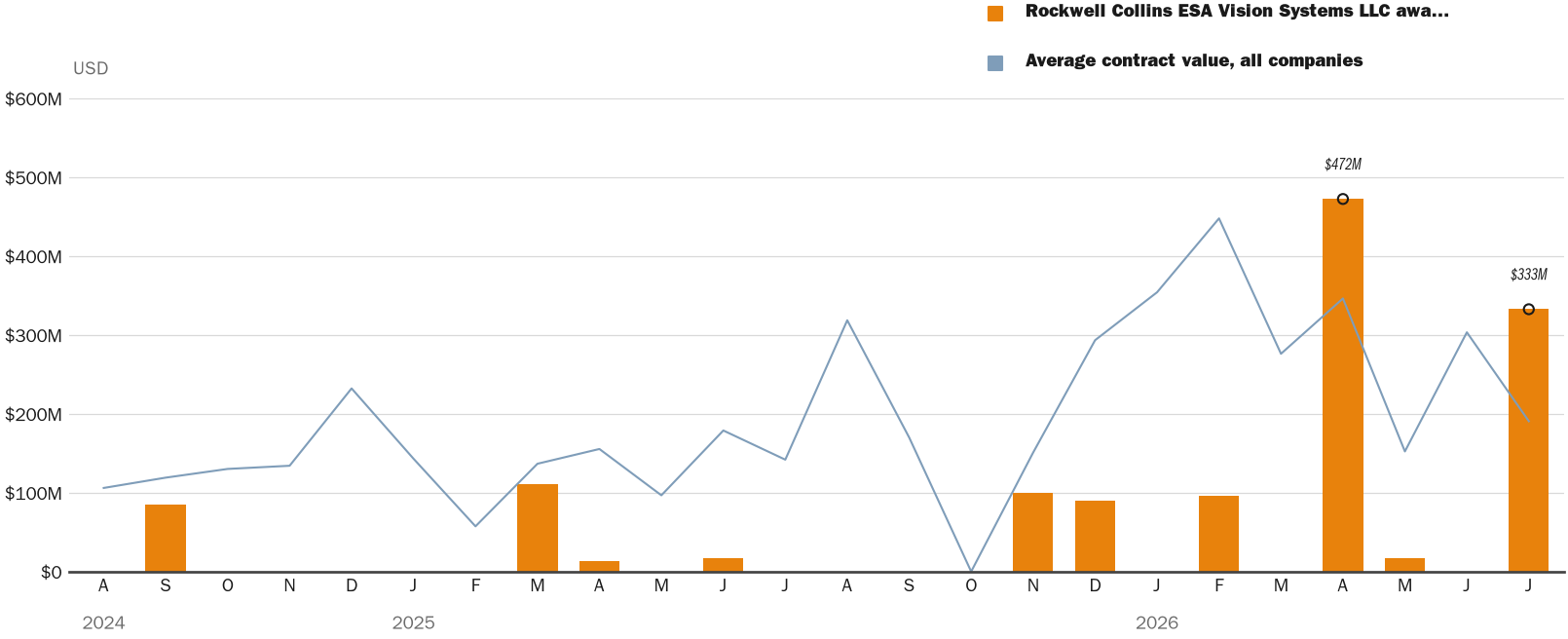
FORT WORTH, TEXAS — Rockwell Collins ESA Vision Systems LLC, a Fort Worth, Texas, maker of pilot helmet display technology, received an estimated $332.6 million contract to supply and repair fighter-jet helmet cueing systems.
The Defense Logistics Agency awarded the fixed-price, indefinite-delivery deal for Joint Helmet Mounted Cueing System consumable and depot-level reparable spares and repairs supporting F-15, F-16 and F-18 aircraft, according to war.gov. The agreement runs six years with a single six-month option and carries a July 23, 2032, completion date, according to war.gov. The award used a sole-source justification under 10 U.S. Code 3204 (c)(2), as stated in Federal Acquisition Regulation 6.302-1, according to war.gov. Work will take place in Texas, Oregon and Israel, and the Defense Logistics Agency Weapon Support unit in Warner Robins, Georgia, manages the contract, according to war.gov.
The Joint Helmet Mounted Cueing System lets pilots aim sensors and weapons by turning their heads toward a target, projecting flight and targeting data onto the visor. The award covers routine consumable parts and higher-cost depot-level repairs, sustaining aircraft already in service rather than building new hardware.
Customers reach well beyond the U.S. military. The Air Force and Navy draw on the contract alongside Foreign Military Sales to Greece, Morocco, Singapore, Chile, Denmark, Norway, Thailand, Oman, Taiwan, Portugal, Canada, Switzerland and Australia, according to war.gov. That roster ties the deal to allied air forces flying American-built fighters across four continents.
Sustainment contracts of this kind keep fielded fighter fleets combat-ready long after production ends, which lowers the risk of grounded aircraft for allied partners. Taxpayers fund the work through fiscal 2026 through 2032 defense working capital funds, military services funds and Foreign Military Sales funds, according to war.gov. Allied buyers cover their own shares through the sales program, spreading cost across the participating nations.
This contract does not touch the daily routine of most American readers directly. It reflects the recurring cost of maintaining aircraft that anchor U.S. and allied air power, a bill that returns every budget cycle as older jets stay in service.
Sole-source sustainment awards for helmet cueing gear have happened before. The Defense Logistics Agency and the military services routinely renew such agreements with the original supplier because the specialized hardware and technical data rest with one manufacturer. The current justification under Federal Acquisition Regulation 6.302-1 continues that pattern, according to war.gov.
The Defense Logistics Agency Weapon Support office will issue delivery orders against the contract as the services and foreign customers submit requirements, according to war.gov. A date for the first order has not been announced.
Helmet-mounted sighting reshaped air combat before this award. South African and Soviet engineers pioneered helmet-cueing systems in the 1970s and 1980s. The technology first stunned Western pilots when German MiG-29s, inherited after reunification in 1990, paired the Archer missile with helmet sights that locked targets far off the aircraft’s nose. That advantage pushed the United States and its partners to field their own systems on legacy fighters, the very jets this contract now keeps flying.

NewsFindr Chart Maker
Photo by NewsFindr Chart Maker

OpenTopoMap / Natural Earth – Fort Worth, Texas