Trump Says Judge Rejected New York Times Bid to Toss Defamation Suit
Trump claims a federal judge denied The New York Times' motion to dismiss his defamation lawsuit and ordered him to file an updated, more detailed complaint.

WASHINGTON D.C. — Donald J. Trump said a federal judge rejected an attempt by The New York Times Company Class A, the largest metropolitan daily newspaper in the United States, to dismiss his defamation lawsuit.
The president said the court instead ordered him to file an updated complaint. That filing would detail claims that the newspaper acted with actual malice against him, his family and his political movement, he said in the post.
“As we requested, the Highly Respected Judge has called for an updated complaint, which will lay out, in extreme detail, all the ways in which The Times has repeatedly and consistently acted, with actual malice in defaming me, my family, our Great MAGA Movement, and America, itself,” Trump said in the post.
The development marks the latest turn in a decade of open hostility between the president and one of the nation’s most influential news organizations. The fight now moves into the pleading stage of active litigation.
Here is the full post on truthsocial: “BREAKING NEWS: The Failing New York Times Company Class A, after 10 years of harassment, slander, and libel, just failed again in their desperate attempt to have our powerful Defamation Lawsuit against them dropped. As we requested, the Highly Respected Judge has called for an updated complaint, which will lay out, in extreme detail, all the ways in which The Times has repeatedly and consistently acted, with actual malice in defaming me, my family, our Great MAGA Movement, and America, itself. We will continue to hold The Times and their “comrades” in the Mainstream Media accountable for publishing, promoting, and dealing in Fake News. Thank you for your attention to this matter! Trump” on July 27, 2026 at 7:30 PM ET.
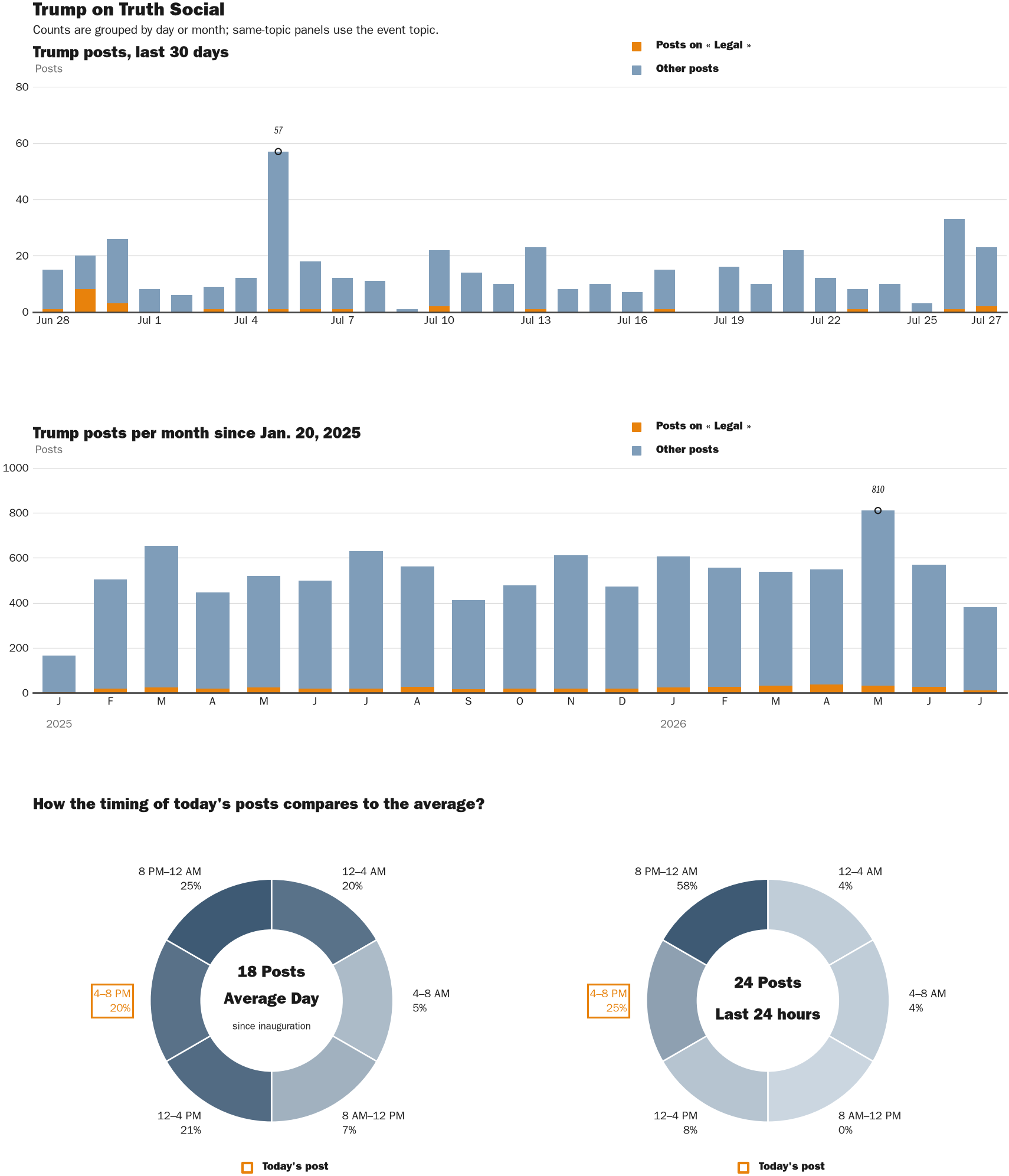
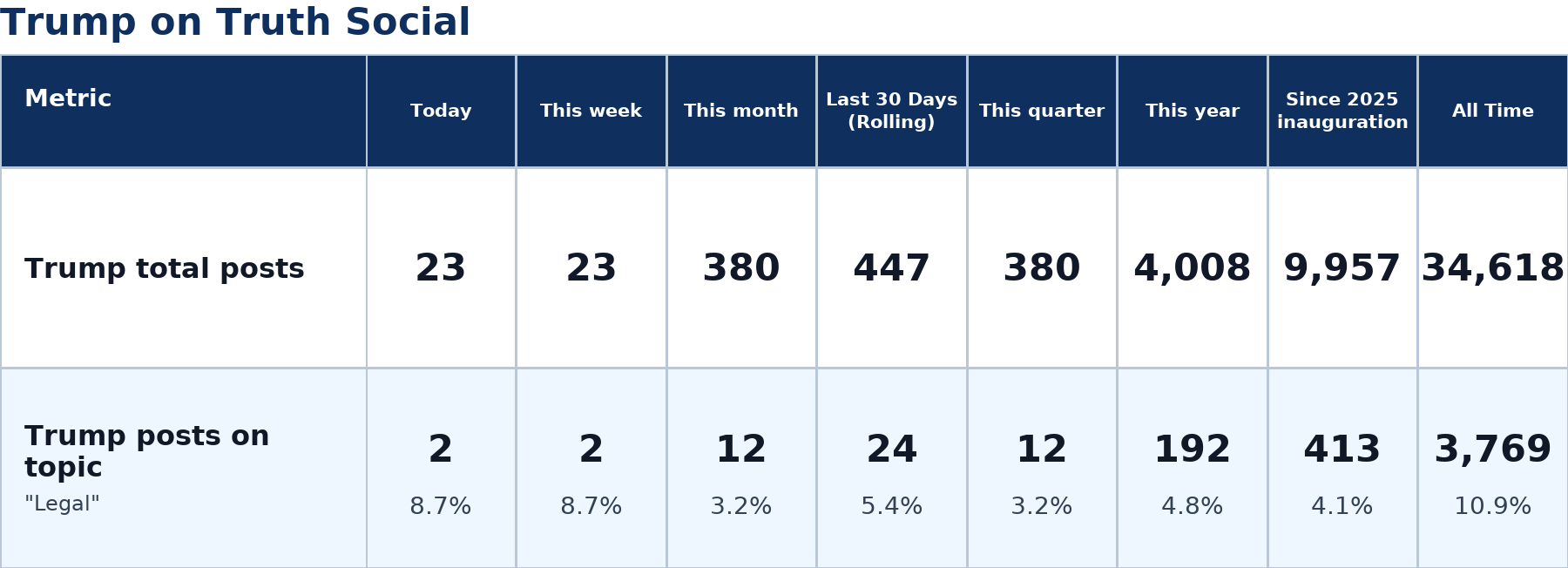
This is the 23rd message released by Trump today. On average, Trump produces 18 posts per day since his inauguration on January 20, 2025.
The move fits a broader pattern in Trump’s recent messaging, with 24 of his 447 posts over the last 30 days focused on legal matters.
An order calling for an amended complaint often signals that a judge sees potential deficiencies in the original filing while still allowing the case to proceed. A defamation claim brought by a public official carries a heavy legal burden. A public figure must prove that a publisher acted with actual malice, meaning it knew a statement was false or showed reckless disregard for the truth. That standard, established in the landmark New York Times Company Class A. v. Sullivan ruling, sets a high bar that has protected news organizations for six decades.
The stakes reach beyond the two parties. A favorable outcome for the president could embolden other public officials to pursue media outlets, while a defeat would reinforce the broad protections that shield reporting on people in power. News organizations, press-freedom advocates and the president all hold a direct interest in how the court applies the malice standard.
For the average reader, the case tests the durability of long-standing rules that govern what journalists can publish about elected leaders. Those rules shape the reporting that reaches households every day, from coverage of campaigns to investigations of government conduct.
Conflict between presidents and the press has happened before. Sitting presidents have clashed with major newspapers throughout American history, though defamation suits filed by a president against a news organization remain rare. The current dispute continues a pattern of legal and rhetorical combat that Trump has waged with the newspaper for years.
The next decision rests with the trial court, which will review the amended complaint once Trump files it and rule on whether the case can advance. A date for that ruling has not been announced.
The collision between the White House and the press is far from new. President Abraham Lincoln’s administration shuttered newspapers during the Civil War, and in 1918 the government prosecuted publishers under the Sedition Act, according to britannica.com. The Sullivan decision of 1964 arose from a libel judgment of $500,000 awarded in Alabama against The New York Times Company Class A. The Supreme Court reversed that judgment and transformed it into the enduring shield that defendants in press cases invoke to this day.
Assigned topic: Legal.
This is Trump’s 23rd Truth Social post today, out of 23 total today.
On average, Trump produces 18 posts per day since his inauguration on January 20, 2025.
Trump’s last post was 0 minutes ago.
This post is not part of a thread.

NewsFindr Chart Maker
Photo by Zenger real-time database of all Truth Social posts.
Zenger analysis
Photo by Zenger analysis