
Army Awards Lockheed Martin $19.8 Million for Stinger Missile Warheads
The firm-fixed-price, indefinite-delivery contract (W15QKN-26-F-A236) to Lockheed Martin Sippican Inc. of Liverpool, New York, funds Stinger warhead and fuze production.

Lockheed Martin Sippican Inc., the Liverpool, New York, arm of the largest U.S. defense contractor by sales, received a $19.8 million Army contract to produce Stinger missile warheads and fuzes, as announced on war.gov.
The firm-fixed-price, indefinite-delivery, indefinite-quantity action, coded W15QKN-26-F-A236, first surfaced July 28, 2026, as an undefinitized contract. The Army confirmed the award landed July 30, 2026. The deal covers warheads and fuzes for the Stinger, a shoulder-fired, infrared-guided surface-to-air missile that troops use to knock down low-flying aircraft, helicopters and drones. Because the contract is undefinitized, the Army authorized work to begin before it settled final terms, price and scope, a structure that speeds urgent munitions production while leaving pricing for later negotiation.
The award marks the company’s first Army benchmark in the database for 2026 and ranks as the 32nd Department of Defense contract in New York this year. It sits far below the year-to-date Army maximum near $53.9 billion and above the year-to-date minimum near $9 million, and it counted among nine Department of Defense contracts issued nationwide that day. Stinger production feeds a broader modernization push, and the Army now expands testing of its “Hammer of the Gods” electronic-warfare system, a low-signature emitter built to scramble the positioning, navigation and timing signals that guide enemy precision weapons, according to fox10phoenix.com. The Army, Navy and Space Force ran the system under Project Convergence Capstone 6 off the California coast, according to livenowfox.com. “Positioning, Navigation and Timing is the foundation of modern military operations,” said Lt. Col. Darrin Hall. “Counter-PNT effects enhances lethality by impacting the backbone for pinpoint targeting via long range artillery, guided missiles, and cruise munitions.” For the average U.S. reader, the award shows how defense dollars flow into local economies, since production work near Syracuse supports skilled manufacturing jobs and keeps a domestic supply line running. Stinger contracts are not new, as the Army and its industry partners have fielded and replenished the missile for decades, and demand climbed after Western allies shipped large stockpiles abroad. The next decision rests with Army contracting officers, who must definitize the contract’s terms and price. A date for that definitization has not been announced.
The Stinger has shaped battlefields for more than 40 years. The Army introduced the missile in 1981, and it gained fame in the 1980s when Afghan fighters used it against Soviet aircraft, downing scores of helicopters and gunships and helping tilt that conflict, according to army.mil. Manufacturers who kept the production line alive through lean years watched demand surge again as modern conflicts revived the need for man-portable air defense.
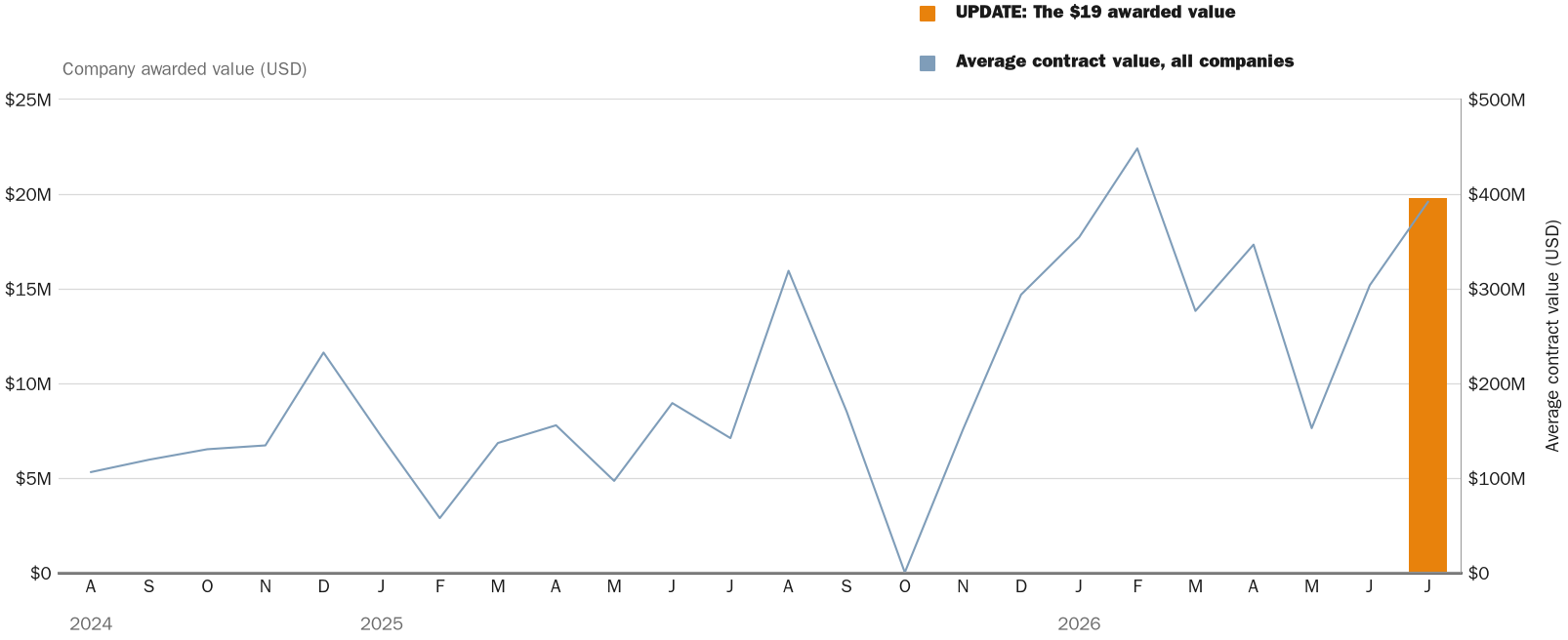
This contract represents the 1st contract awarded to UPDATE: The $19, in 2026, bringing the company’s total contract value for the year to $19,791,630. It is also the 32nd Department of Defense contract awarded in New York during 2026. Because this is the first award to UPDATE: The $19 recorded in the database, it establishes the company’s initial benchmark within the Army portfolio. Specifically, it falls between the 2026 Army portfolio’s year-to-date minimum of $9,051,490 and maximum of $53,859,843,289. Overall, this award was announced among 9 Department of Defense contracts issued nationwide on July 30, 2026.

NewsFindr Chart Maker
Photo by NewsFindr Chart Maker