K2 Space Awarded $22.9 Million Space Force Deal for Hosted Sensor Terminals
The Torrance, California, satellite maker will build, launch and operate two Enterprise Space Terminals as hosted payloads on its own space buses, with work due by November 2028.

TORRANCE, CALIFORNIA — K2 Space, the Torrance, California, satellite maker founded in 2022 by former SpaceX engineers, received a $22.9 million Space Force contract to build and operate two hosted sensor payloads, as announced on war.gov.
The firm-fixed-price award covers procuring, integrating, launching and operating two Enterprise Space Terminals on two separate K2 Space buses as hosted payloads, according to war.gov. Fiscal 2025 research, development, test and evaluation funds of $22.9 million were obligated at the award, and work should finish by November 2028.
“The industry went small. We asked: what happens if you go the other way?” said Neel Kunjur, chief technical officer of K2 Space, according to k2space.com.
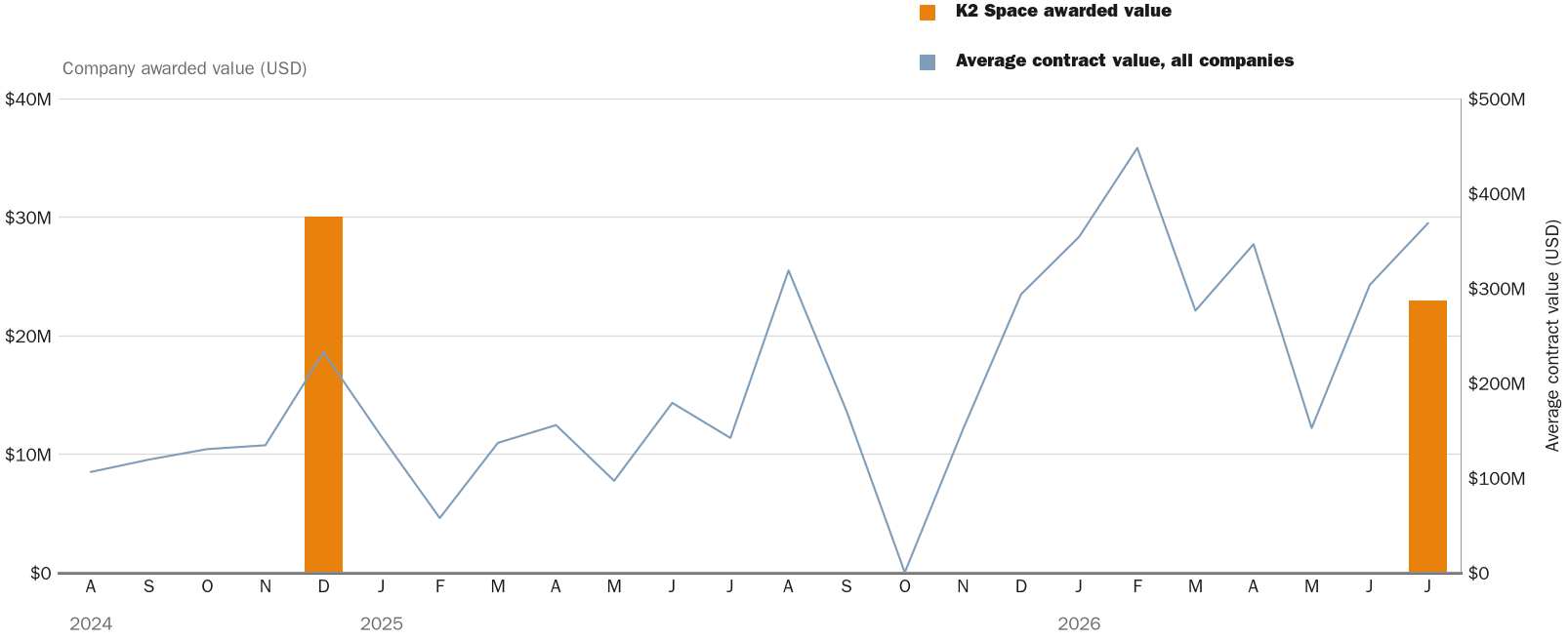
The deal marks the first federal contract recorded for K2 Space, setting the company’s initial benchmark within the Air Force portfolio, according to firestore:contracts. It ranks well below the 2026 Air Force year-to-date maximum of $5.6 billion and above the year-to-date minimum of $17. The award was one of eight Department of Defense contracts issued nationwide on July 31, 2026, and the 14th recorded in California this year.
The FreeSol Broad Agency Announcement leveraged the contract, and the Space Based Sensing and Targeting Directorate at Space Systems Command, Los Angeles Air Force Base, California, serves as the contracting activity, according to war.gov. The arrangement lets the government mount sensor terminals on commercial satellite platforms rather than fund a dedicated spacecraft, a model that spreads mission risk and can shorten schedules.
K2 Space builds what it calls Mega Class satellite buses, large high-power platforms that deliver roughly 10 times the payload power of constellation-class satellites, 20 kilowatts against 2 kilowatts, according to k2space.com. The company builds 80% of each satellite in-house and targets stacking 10 Mega Class satellites per launch vehicle. That vertically integrated, mass-production approach challenges the small-satellite cost model that has dominated the industry.
The company has scaled quickly since its founding.K2 Space has raised $398 million across six funding rounds, most recently a $250 million Series C in December 2025, according to startupintros.com. It grew from 25 to about 90 employees in 2024 and expanded its production facility from 15,000 to 180,000 square feet, according to startupintros.com. Late-stage reporting placed the company’s valuation near $3 billion after strong contract bookings.
For the average reader, the award reflects how the Pentagon increasingly rents space on privately built satellites to field sensors faster and cheaper than legacy programs allow. That shift shapes how tax dollars fund missile-warning, communications and surveillance capabilities that underpin national defense.
This has happened before.K2 Space and Rocket Lab won supplier roles in a Space Force satellite communications program in June 2026, and the Space Force tapped K2 satellites to test laser communications for missile defense in April 2026, according to k2space.com. Hosted-payload arrangements have become a recurring tool for the service as it seeks proliferated, resilient constellations.
Space Systems Command will oversee delivery of the terminals, with performance due by November 2028. No date for the next milestone decision or follow-on award has been announced.
Large, powerful satellites mark a return to an older idea, not a wholly new one. Early communications spacecraft grew heavier through the 1990s before the industry pivoted to small, cheap satellites launched in swarms, a shift that ventures flying hundreds of low-orbit units crystallized according to thenextweb.com.K2 Space bet that next-generation heavy rockets would again reward size, echoing the era when bigger buses carried the most valuable payloads and, for the operators who backed them, defined the market.
This contract represents the 1st contract awarded to K2 Space, in 2026, bringing the company’s total contract value for the year to $22,947,034. It is also the 14th Department of Defense contract awarded in California during 2026. Because this is the first award to K2 Space recorded in the database, it establishes the company’s initial benchmark within the Air Force portfolio. Specifically, it falls between the 2026 Air Force portfolio’s year-to-date minimum of $17 and maximum of $5,600,000,000. Overall, this award was announced among 8 Department of Defense contracts issued nationwide on July 31, 2026.

NewsFindr Chart Maker
Photo by NewsFindr Chart Maker
OpenTopoMap / Natural Earth – Torrance, California