Trump Mail Voting Restrictions Survive Democratic Court Challenge
Trump celebrates a D.C. Circuit ruling that declined to block his mail-in voting overhaul, though judges warn they may rule differently before the November election.

WASHINGTON D.C. — Donald J. Trump claimed victory in his push to reshape mail-in voting rules after a federal appeals court declined to block his executive order.
The U.S. Court of Appeals for the District of Columbia Circuit on July 28 turned down a bid from Democrats, including Senate Minority Leader Chuck Schumer, to halt the president’s overhaul, according to theepochtimes. The panel upheld a May ruling from a federal judge in Washington that rejected a request to enter a preliminary injunction. That order directed federal officials to compile lists of American citizens and to compel states to let only those on the lists register and vote.
Here is the full post on truthsocial: “Federal Appeals Court Rejects Bid to Block Trump’s Mail Voting Restrictions: https://www.theepochtimes.com/us/federal-appeals-court-rejects-bid-to-block-trumps-mail-voting-restrictions-6.1 million” on July 31, 2026 at 9:46 PM ET.
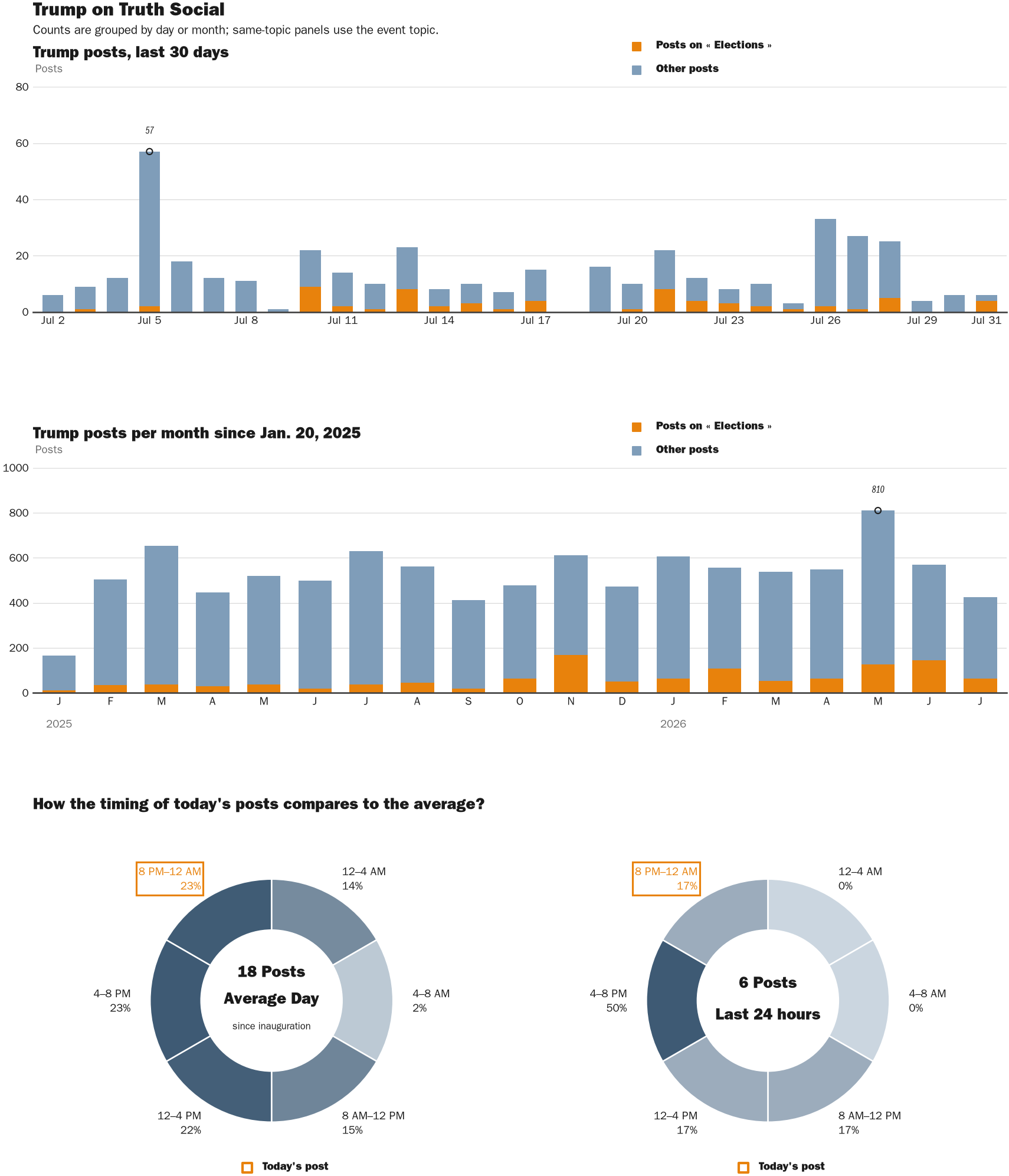
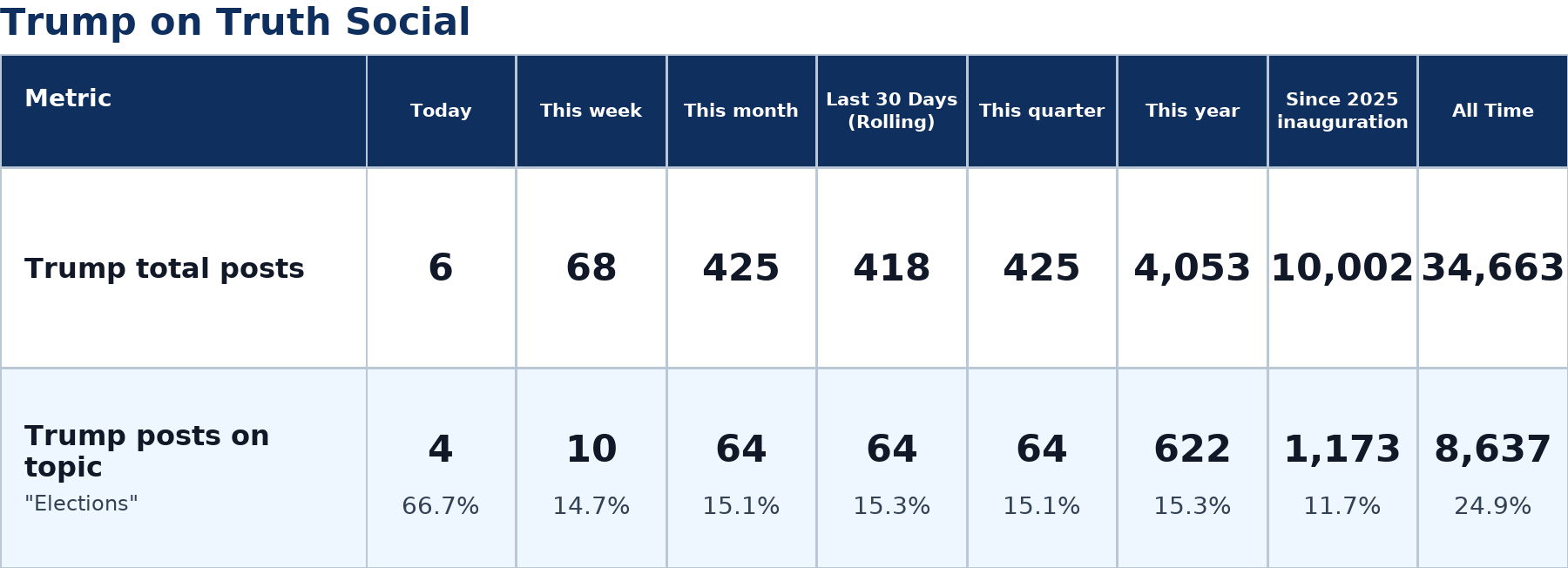
This is Trump’s 6th message released today. On average, Trump produces 18 posts per day since his inauguration on January 20, 2025.
The move fits a broader pattern in Trump’s recent messaging, with 64 of his 418 posts over the last 30 days focused on elections.
“Big win from the D.C. Circuit affirming POTUS efforts to keep our elections safe and fair,” said Brett Shumate, an assistant attorney general, in a statement, by mentioning the source (see theepochtimes).
The judges warned that their decision rested on timing, not on the underlying legality of the order. “While Plaintiffs have identified a number of serious questions concerning the lawfulness of proposed actions if implemented on the threshold of the upcoming federal election, this case likely is unripe for review in its present posture,” the panel said in a per curiam opinion. Circuit Judges Patricia Millett, Robert Wilkins, and Gregory Katsas sat on the panel. They added that plaintiffs could promptly seek relief if agencies moved to implement the order in a way that violates federal law or the Constitution.
The stakes divide sharply along partisan lines. Trump and his administration argue the order protects election integrity by limiting registration and voting to verified citizens. Democrats and voting-rights groups warn that the plan risks disenfranchising eligible voters if states must purge rolls against federal lists.
The D.C. ruling was not the only front in the fight. A different federal judge in June blocked the order in about two dozen states and the District of Columbia, which had sued the administration in federal court in Massachusetts. That judge found that the order exceeded the powers of the president. A U.S. Court of Appeals for the First Circuit panel upheld the ruling in a 2-1 decision, warning that letting the order take effect “would sow confusion and threaten disenfranchisement of many eligible voters.”
For the average voter, the outcome could determine how a ballot is cast in November. Mail-in voting has grown into a mainstay of American elections. Any shift in registration verification would ripple into county election offices nationwide.
This is not the first time Trump’s executive orders have collided with the courts over election machinery. Federal appeals courts have repeatedly split over his directives, deepening divides that increase the odds of Supreme Court review, according to houstonchronicle.com.
The next decision rests with the U.S. Supreme Court. The Trump administration on July 26 asked the justices to intervene. Solicitor General D. John Sauer argued that the injunction irreparably harms the government because there is not enough time to obtain ordinary appellate relief before the November election. A date for a ruling from the high court has not been announced.
Election disputes reaching the nation’s highest court have reshaped American politics before. In Bush v. Gore, decided December 12, 2000, the Supreme Court halted a Florida recount by a 5-4 vote, sealing George W. Bush’s 537-vote margin in the state and the presidency itself. That decision, resolved 36 days after Election Day, showed how a single ruling on voting procedure can decide who governs.
Assigned topic: Elections.
This is Trump’s 6th Truth Social post today, out of 6 total today.
On average, Trump produces 18 posts per day since his inauguration on January 20, 2025.
Trump’s last post was 4 hours ago.
This post is not part of a thread.

NewsFindr Chart Maker
Photo by Zenger real-time database of all Truth Social posts.
Zenger analysis
Photo by Zenger analysis