Trump Touts Campus Free Speech at 20-Year High in New FIRE Report
Trump shares a report finding fewer than 10% of public colleges earned the worst free-speech rating for the first time in two decades, though critics dispute the trend.

WASHINGTON D.C. — Donald J. Trump promoted a new finding that campus free speech has reached a 20-year high, sharing an analysis that credits improving conditions at public colleges to his administration.
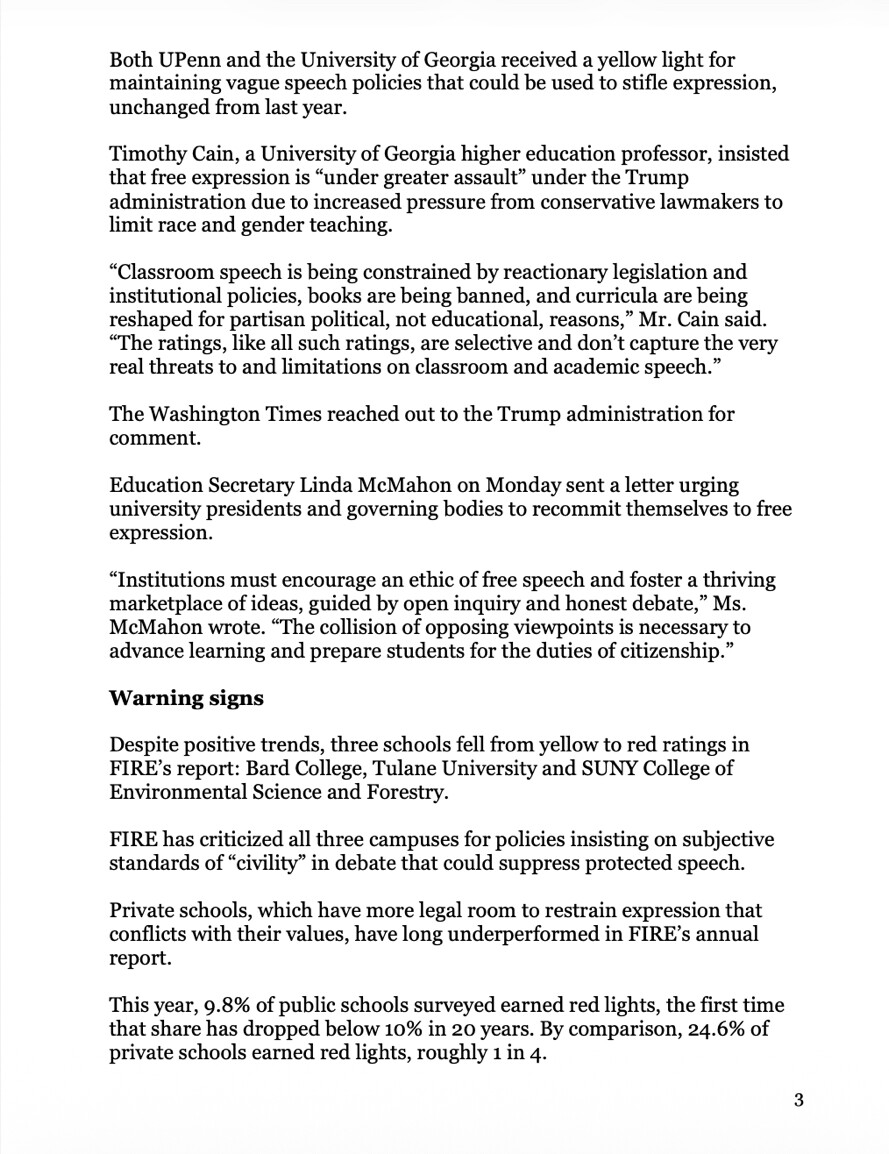
Fewer than 10% of surveyed public schools earned red-light ratings this year, the first time that share has dropped below the threshold in two decades. Private schools fared worse, with 24.6% earning red lights, roughly 1 in 4, according to the report from the Foundation for Individual Rights and Expression.
“Institutions must encourage an ethic of free speech and foster a thriving marketplace of ideas, guided by open inquiry and honest debate,” Education Secretary Linda McMahon wrote in a letter urging university presidents and governing bodies to recommit to free expression. “The collision of opposing viewpoints is necessary to advance learning and prepare students for the duties of citizenship.”
The post signals how the administration frames its higher-education agenda as a defense of open inquiry, even as opponents argue the same policies chill classroom teaching on race and gender.
Here is the full post on truthsocial: “Campus free speech hits 20-year high under Trump administration: https://www.washingtontimes.com/news/2026/aug/3/fire-report-finds-free-speech-improving-colleges-trump-administration/” on August 4, 2026 at 10:43 AM ET.
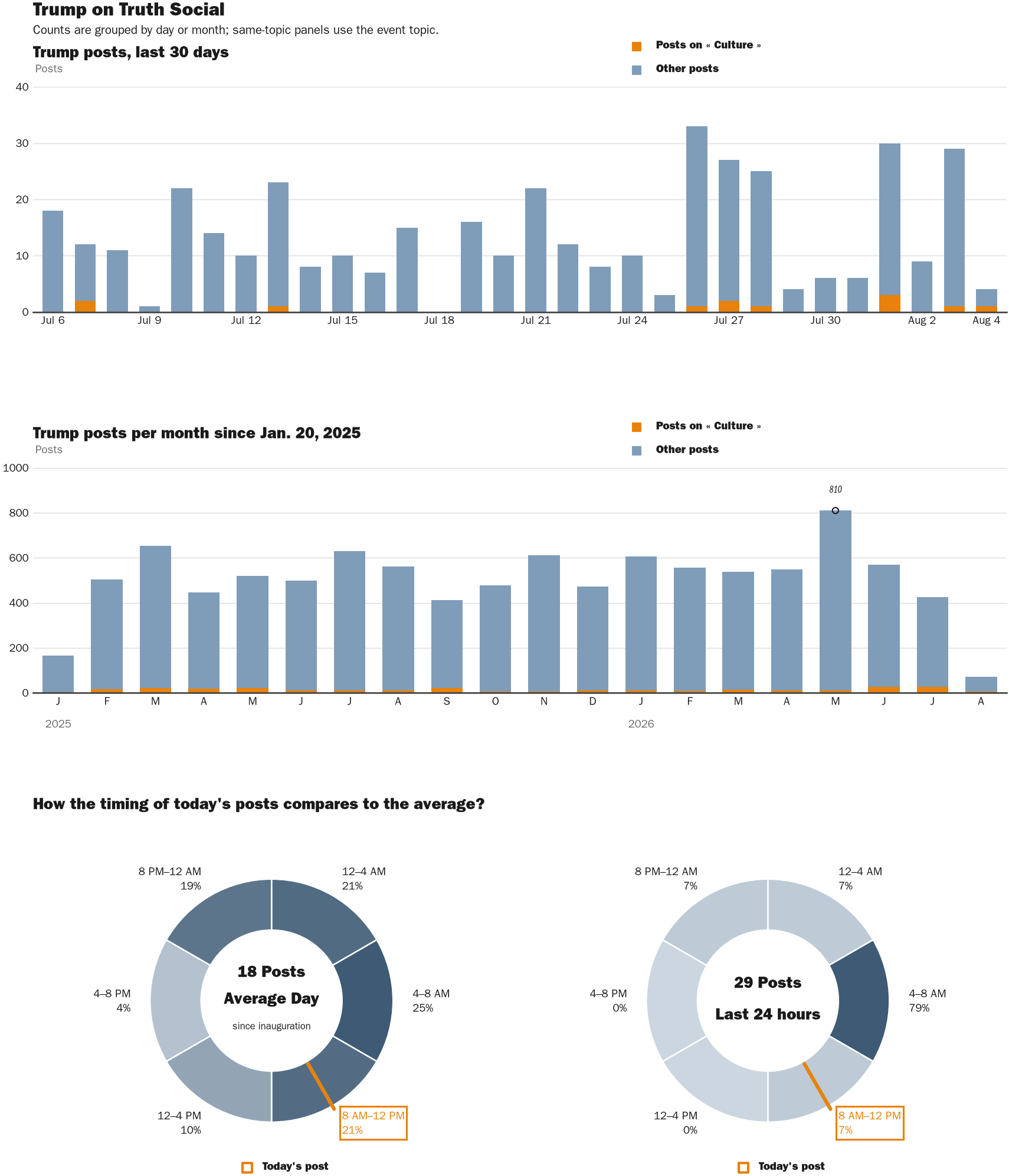
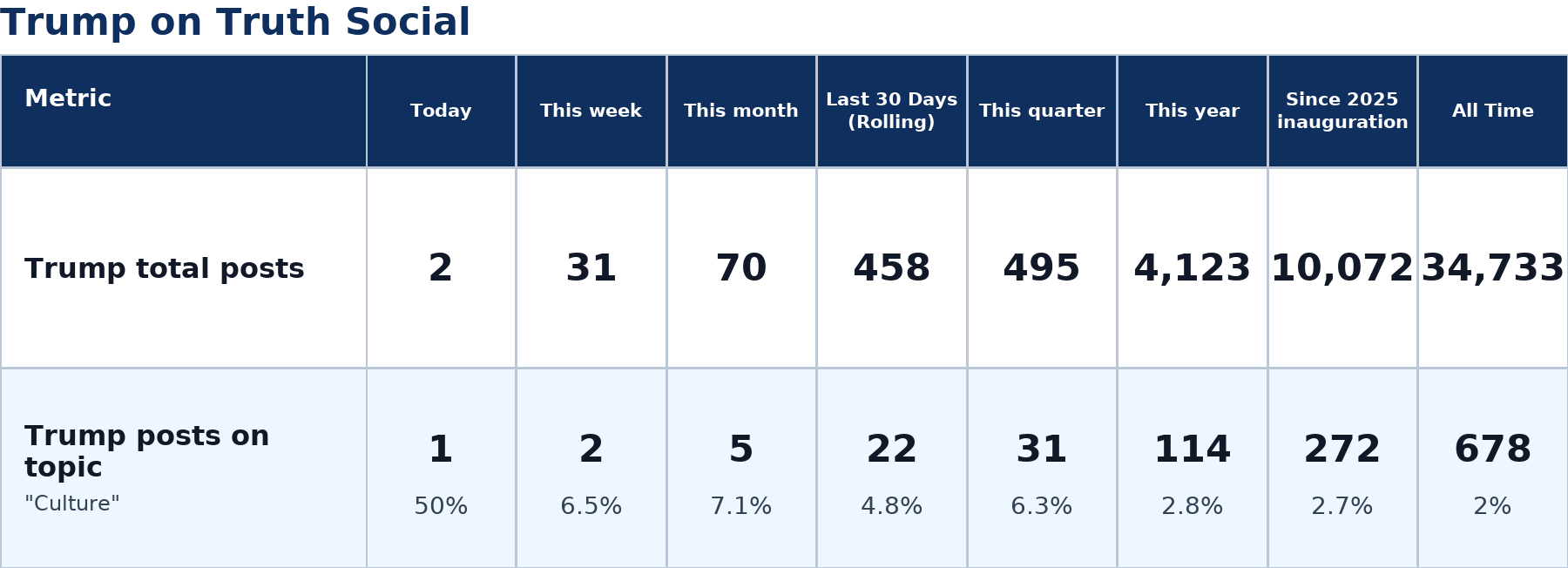
This is Trump’s 2nd message released today, and the last post was 3 hours ago, and it is not part of a thread. On average, Trump produces 18 posts per day since his inauguration on January 20, 2025. The move fits a broader pattern in Trump’s recent messaging, with 22 of his 458 posts over the last 30 days classified as Culture posts.
The report drew a rebuttal from within academia. Timothy Cain, a University of Georgia higher education professor, insisted that free expression is “under greater assault” under the Trump administration because of pressure from conservative lawmakers to limit race and gender teaching, Trump mentioned the source (see washingtontimes). “Classroom speech is being constrained by reactionary legislation and institutional policies, books are being banned, and curricula are being reshaped for partisan political, not educational, reasons,” Cain said. He added that the ratings “are selective and don’t capture the very real threats to and limitations on classroom and academic speech.”
Both the University of Pennsylvania and the University of Georgia received a yellow light for maintaining vague speech policies that could stifle expression, unchanged from last year. Three schools fell from yellow to red ratings: Bard College, Tulane University and SUNY College of Environmental Science and Forestry. The group has criticized all three campuses for policies insisting on subjective standards of “civility” in debate that could suppress protected speech.
The divide between public and private schools carries real stakes for students and faculty. Private schools have more legal room to restrain expression that conflicts with their values, and they have long underperformed in the annual report. Restrictions on speech by public colleges and universities amount to government censorship in violation of the Constitution, according to aclu.org. That distinction explains why public campuses face tighter First Amendment obligations than their private counterparts.
For the average reader, the debate touches how tuition dollars and tax funding shape what can be said and taught on campus. Students at public universities gain the clearest constitutional protections, while those at private institutions rely on school policies that vary widely.
This has happened before. Campus speech fights have recurred for decades, with the ACLU defending controversial speakers and challenging restrictive codes since its founding in 1920, according to aclu.org. The current report continues a long-running measurement of policy language that determines each school’s rating.
The next move rests with university presidents and governing boards, which McMahon urged to revise policies. A specific date for any response from the schools has not been announced.
Disputes over what can be said inside American lecture halls stretch back generations, as happened before. During the loyalty-oath battles of the 1950s, the University of California fired 31 faculty members in 1950 who refused to sign anti-communist pledges, according to aaup.org. Courts later ruled the dismissals improper, and the association censured the institution. That rebuke shadowed the university for years and forced a slow rebuilding of its reputation for academic freedom.

NewsFindr Chart Maker
Photo by Zenger real-time database of all Truth Social posts.
Zenger analysis
Photo by Zenger analysis