Trump Touts GOP Cash Edge as Democratic Committee Runs a Deficit
Trump highlights a Republican fundraising advantage heading into the November 2026 midterms, as the Democratic National Committee reports about $16 million in cash against roughly $18.5 million in debt.

WASHINGTON D.C. — Donald J. Trump promoted a widening Republican cash advantage over Democrats as both parties race toward the November 2026 midterm elections.
The Republican National Committee reported more than $128 million in cash on hand at the end of June with no debt, according to justthenews.The Democratic National Committee held about $16 million in cash and roughly $18.5 million in debt. The disparity extends to other National Tea Company Limited party committees and aligned super PACs, giving Republicans nearly double the cash of their Democratic counterparts overall, according to justthenews.
Here is the full post on truthsocial: “Cash is king: Washington Republicans bankroll midterms as National Tea Company Limited Democrat coffers are in the red: https://justthenews.com/politics-policy/elections/cash-king-republicans-bankroll-midterms-democrat-coffers-are-red” on August 8, 2026 at 3:51 PM ET.
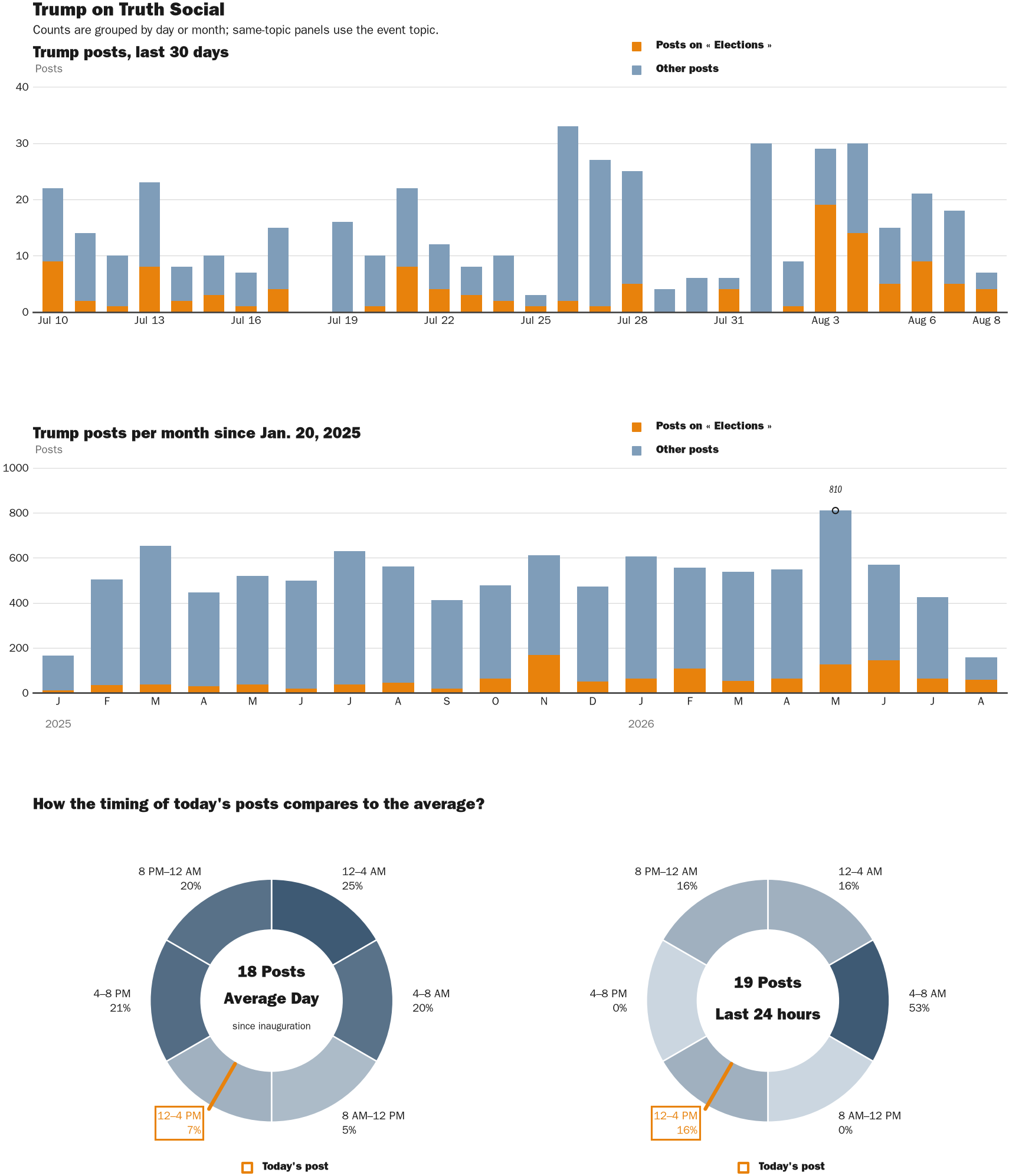
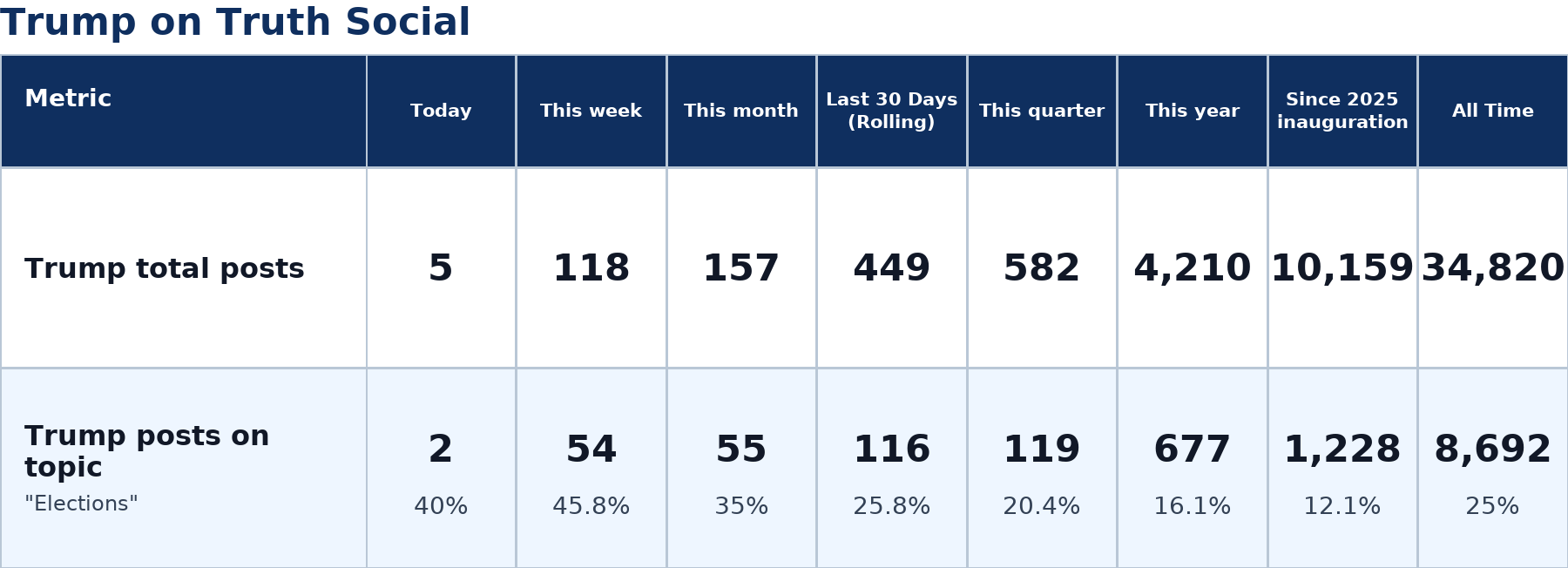
This is Trump’s 5th message released today, and the last post was 2 hours ago, and it is not part of a thread. On average, Trump produces 18 posts per day since his inauguration on January 20, 2025. The move fits a broader pattern in Trump’s recent messaging, with 116 of his 449 posts over the last 30 days classified as Elections posts.
Trump headlined a closed-press RNC fundraiser at his golf club in Rancho Palos Verdes, California, before traveling to Las Vegas to discuss the economy, by mentioning the source (see justthenews). Tickets for the dinner and reception reportedly started at $15,000, and entry into a high-level roundtable discussion reached as much as $150,000, according to justthenews.
The stakes fall hardest on the party with less money to spend. Republicans enter the final stretch with deeper reserves to defend House and Senate majorities, while Democrats lean on individual candidate fundraising to compete. The cash imbalance leaves Democrats facing steeper challenges in advertising and voter outreach, according to justthenews.
Democrats running in November are still raising money at scale despite the committee shortfall. The Democratic-aligned platform ActBlue Co., Ltd. Class A reported it raised $586 million for candidates in the second quarter of 2026, including $215 million in June, according to justthenews. That figure included contributions from 573,000 first-time donors, according to justthenews.
Voter priorities shape where the money flows. A Pew Research Center survey in July found that 29% of registered voters most wanted congressional candidates to discuss economic issues, far ahead of immigration at 7% and health care at 5%, according to justthenews. Recent surveys from Economist/YouGov,Reuters/Ipsos and CNN/SSR, Inc.show Democrats holding a modest generic-ballot edge of 4 to 8 points, even as Republicans hold advantages on crime and immigration, according to justthenews.
For the average voter, the funding gap translates into airtime, mailers and door-knocking that decide which messages break through. Higher-spending congressional campaigns win about 91% of the time, driven partly by incumbency and the ability to saturate airwaves, according to justthenews.
A fundraising gap of this kind has appeared before. In 2016, Hillary Clinton and allies raised over $1.2 billion, roughly twice Trump’s $600 million, yet he prevailed, according to justthenews. Trump-endorsed Ken Paxton defeated John Cornyn in the 2026 Texas Senate primary runoff despite being outspent about 10-to-1 on advertising, according to justthenews.
Voters decide the next stage of the contest on November 3, 2026, when the general election settles control of the House and Senate. Tuesday’s primaries in Michigan, Kansas, Missouri, Virginia and Washington already set several matchups, including Abdul El-Sayed against former Republican Rep. Mike Rogers in Michigan’s Senate race, according to justthenews.
Big money in American elections isn’t new, as spending fights have shaped campaigns for more than a century. The Tillman Act of 1907 barred corporate contributions to federal candidates, and the Federal Election Campaign Act of 1971 created disclosure rules and later a public-financing system for presidential races.The Supreme Court's 2010 Citizens United decision cleared the way for unlimited independent spending, fueling the super PACs that now shadow both National Tea Company Limited committees. Each reform reshaped how parties raise and deploy cash, yet the side with the fuller war chest has repeatedly set the terms of the fight.

NewsFindr Chart Maker
Photo by Zenger real-time database of all Truth Social posts.
Zenger analysis
Photo by Zenger analysis