Trump Amplifies Claim That Barrett Grew Less Conservative After Dobbs
Trump shares a chart alleging Justice Amy Coney Barrett's conservative voting rate fell from 81% to about 50% after the 2022 Dobbs ruling that overturned Roe v. Wade.

WASHINGTON D.C. — Donald J. Trump amplified a claim that Supreme Court Justice Amy Coney Barrett has drifted leftward since the court’s 2022 abortion ruling.
The justice, whom Trump nominated to the high court in 2020, cast conservative votes in 81% of divided cases in the term before Dobbs v. Jackson Women’s Health Organization, according to a chart Trump shared. That figure fell to about 50% by the most recent term, the chart claimed.
Here is the full post on truthsocial: “Tim Pool (@LoneStarLegendX): Amy Coney Barrett is clearly terrified of the left. Amy Coney Barrett’s record tells a troubling story. Before Dobbs, she voted with the conservative position in 81% of non-unanimous cases. Since then, that number has dropped sharply into the 50-60% range in subsequent terms – including on major cases involving … Pre-Dobbs average-73%; Post-Dobbs -55%. She remains aligned more with conservatives than liberals overall, but shows increased cross-aisle voting and a modest leftward ideological drift in later terms. In Dobbs itself, she joined the majority overturning Roe v. Wade.” on July 29, 2026 at 1:03 PM ET.
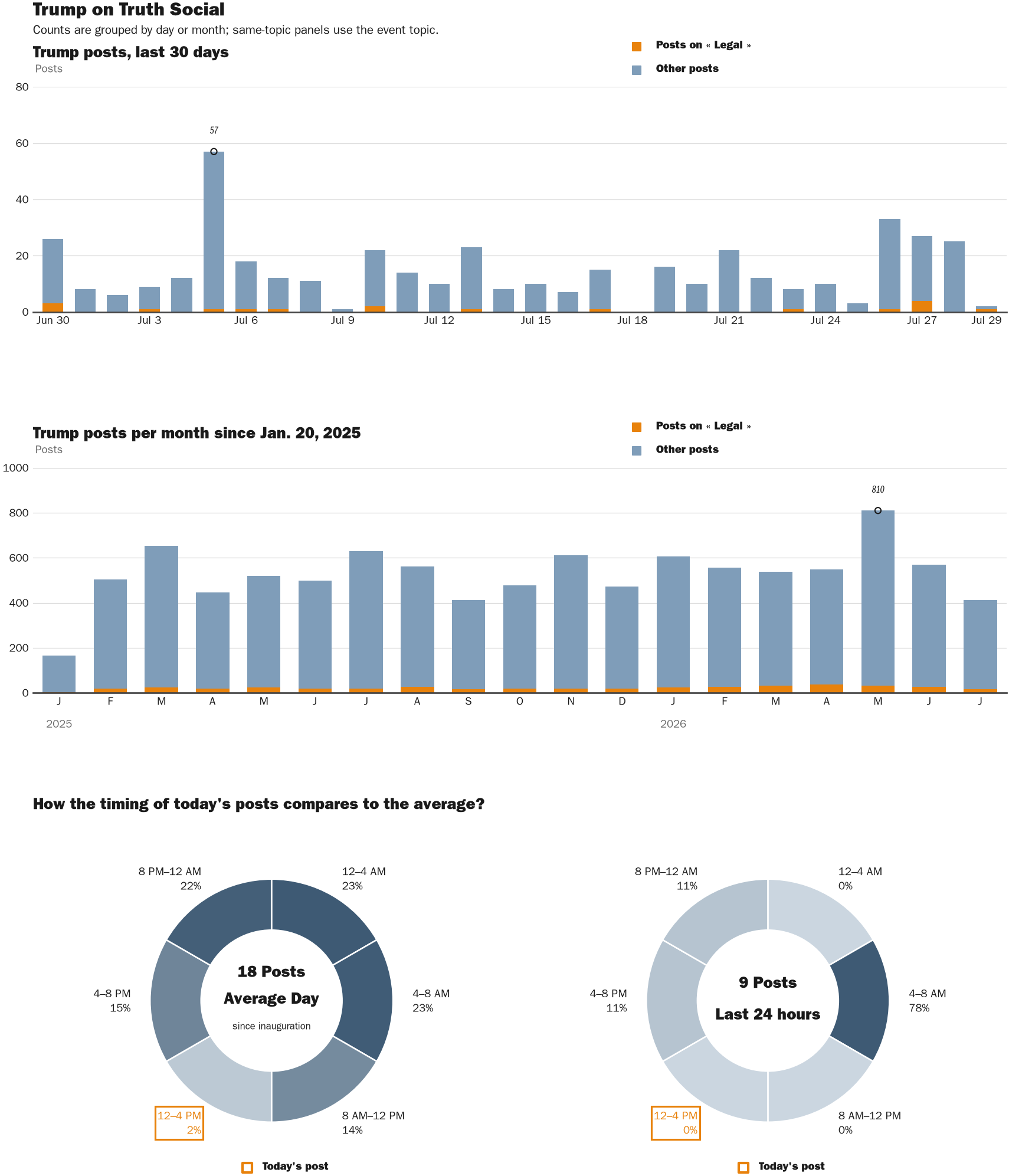
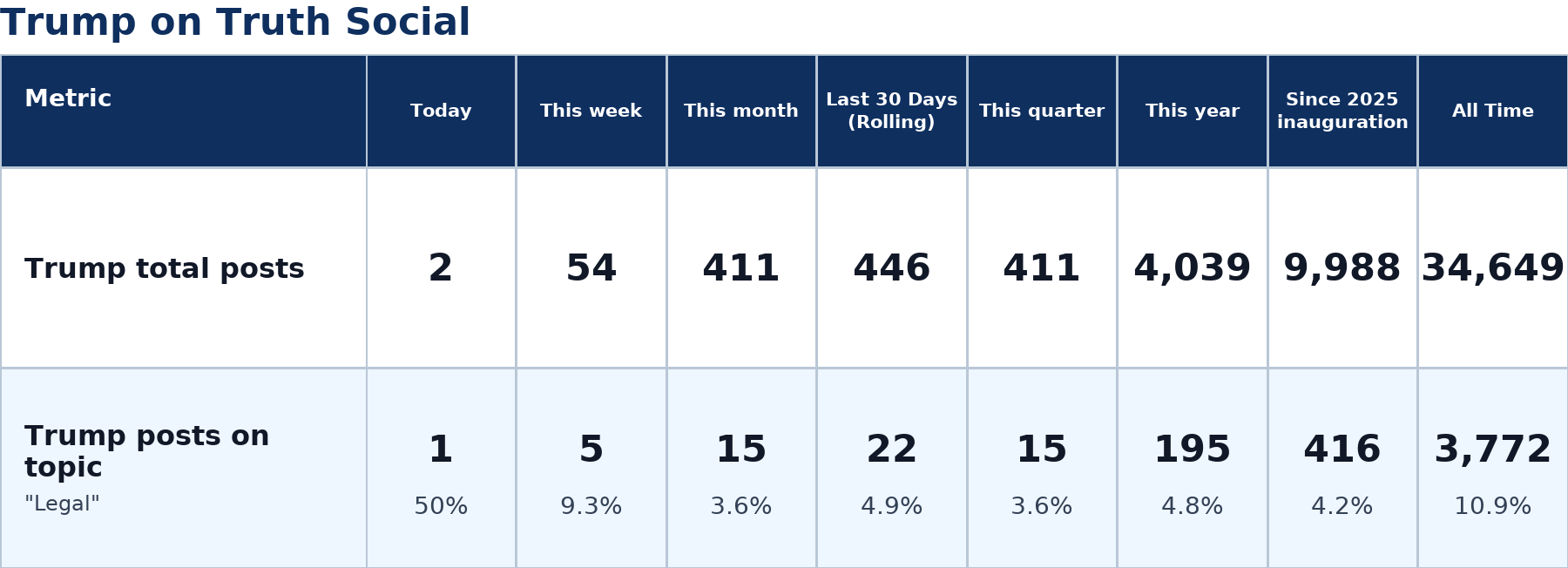
This is Trump’s 2nd message released today. On average, Trump produces 18 posts per day since his inauguration on January 20, 2025.
The move fits a broader pattern in Trump’s recent messaging, with 22 of his 446 posts over the last 30 days focused on legal topics.
The shared image reproduces a post from commentator Tim Pool alongside a graphic attributed to another user, Roscoe Smith IV. Bars in the graphic mark a pre-Dobbs conservative-vote rate of 65% in the 2020 term and 81% in the 2021 term, then 59%, 57% and a partial 50% in the three terms that followed. A red dashed line labels the June 2022 Dobbs decision as the dividing point. The graphic carries a personal watermark rather than a court or academic source, and no independent audit confirms its figures.
The stakes reach beyond one justice. Barrett holds one of nine seats on a court that decides abortion, immigration, executive power and election disputes. Conservative activists who backed her confirmation gain leverage by pressing her to hold a firm line, while the court’s institutional standing suffers when a sitting justice becomes a target of political pressure from the president who appointed her.
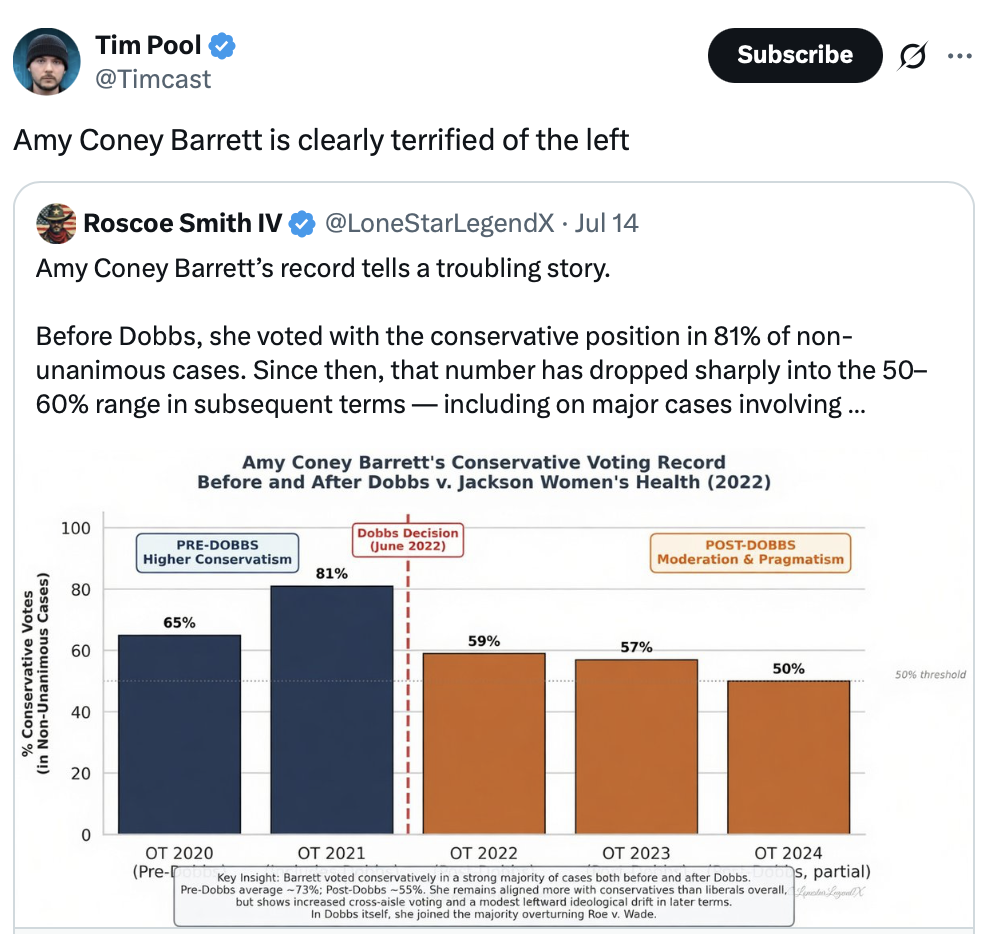

President Donald J. Trump shared a screenshot of a social media post featuring a bar chart at WASHINGTON D.C.
© copyright Zenger.News
Barrett, confirmed to the court in October 2020, joined the five-justice majority that overturned Roe v. Wade in Dobbs, ending a nationwide abortion right that had stood since 1973. The 2022 ruling returned abortion policy to the states and reshaped the legal landscape across the country.
For the average reader, the debate signals how future rulings could land on issues that touch daily life, from access to reproductive care to the limits of presidential authority. A single vote on a closely divided court can decide whether a state law stands or falls.
This is not the first time a president has soured on his own Supreme Court pick. Trump has previously criticized justices he appointed when their votes disappointed him, and public friction between a president and the bench underscores the tension between judicial independence and political expectation.
No formal decision follows from the post, and Barrett has not responded publicly. A date for any next term ruling that would test the claim has not been announced, since the court’s schedule sets argument and opinion dates term by term.
Presidents clashing with their court appointees is a recurring feature of American history. Dwight D. Eisenhower reportedly called his appointment of Chief Justice Earl Warren the biggest mistake of his presidency after Warren led a liberal turn on the court in the 1950s and 1960s. Warren, seated in 1953, presided over the unanimous 1954 Brown v. Board of Education ruling that struck down school segregation, a decision that outlived the president’s disappointment and reshaped the nation.
Assigned topic: Legal.
This is Trump’s 2nd Truth Social post today, out of 2 total today.
On average, Trump produces 18 posts per day since his inauguration on January 20, 2025.
Trump’s last post was 5 hours ago.
This post is not part of a thread.
NewsFindr Chart Maker
Photo by Zenger real-time database of all Truth Social posts.
Zenger analysis
Photo by Zenger analysis