Rockwell Collins Awarded $332.6 Million Fighter Helmet Cueing Contract
The Fort Worth, Texas, unit will supply Joint Helmet Mounted Cueing System spares and repairs for F-15, F-16 and F-18 jets through July 23, 2032, under a sole-source Defense Logistics Agency deal.

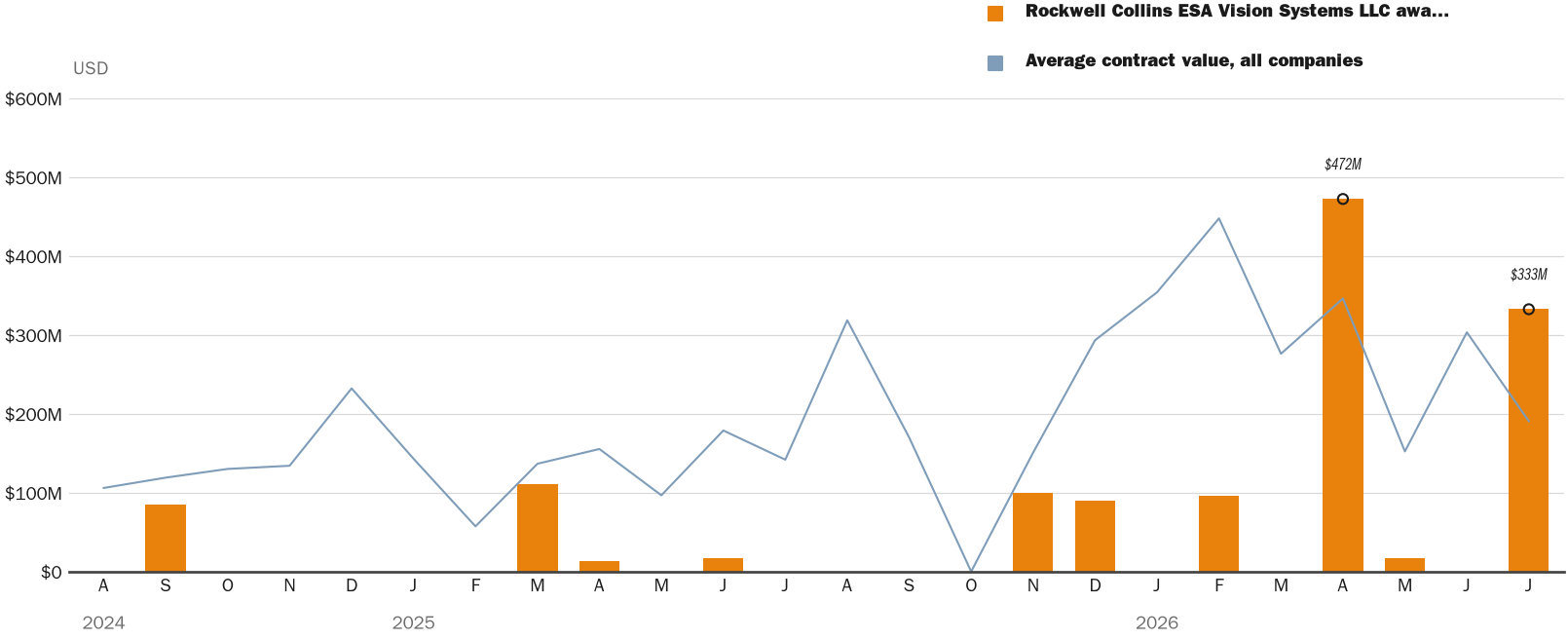
FORT WORTH, TEXAS — Rockwell Collins ESA Vision Systems LLC received an estimated $332.6 million Pentagon contract to sustain the helmet-mounted targeting gear that arms three generations of U.S. and allied fighter jets.
The Fort Worth, Texas, unit won a fixed-price, indefinite-delivery, requirements contract covering Joint Helmet Mounted Cueing System consumable and depot-level reparable spares and repairs for F-15, F-16 and F-18 aircraft, according to war.gov. The award runs as a six-year base contract with one six-month option and carries a July 23, 2032, completion date.
The Defense Logistics Agency issued the deal as a sole-source acquisition, citing 10 U.S. Code 3204 (c)(2) and Federal Acquisition Regulation 6.302-1, according to war.gov. Those provisions let the government bypass competitive bidding when only one supplier can meet the requirement.
The Joint Helmet Mounted Cueing System lets a pilot aim sensors and weapons by looking at a target, projecting flight and targeting data onto the visor. Keeping the equipment flying depends on a steady flow of spares and repairs, the core of this contract.
The stakes reach well beyond the U.S. military. Crews will perform work in Texas, Oregon and Israel, and the using customers include the Air Force, the Navy and Foreign Military Sales to Greece, Morocco, Singapore, Chile, Denmark, Norway, Thailand, Oman, Taiwan, Portugal, Canada, Switzerland and Australia, according to war.gov. Rockwell Collins captures a long-term revenue stream, while the 13 foreign buyers gain assured maintenance for aircraft that anchor their air defenses.
Money flows from fiscal 2026 through 2032 defense working capital funds, military services funds and Foreign Military Sales funds, according to war.gov. The Defense Logistics Agency Weapon Support office in Warner Robins, Georgia, manages the contract under identifier SPRWA1-26-D-0001.
For the average American reader, the award shows how tax dollars sustain aging fighter fleets rather than buy new jets. The F-16 first flew in the 1970s, and the sustainment work reflects the cost of keeping decades-old airframes combat-ready. This award ranked among eight Department of Defense contracts issued nationwide on July 24, 2026, according to war.gov.
Sole-source sustainment awards of this kind have happened before. The Defense Logistics Agency routinely relies on original equipment makers to repair specialized avionics that no other firm can service, and helmet-cueing systems fall squarely in that category. The scale of this deal, spanning three fighter types and 13 export customers, marks it as one of the broader single-vendor spares arrangements in recent memory.
The next decision rests with the Defense Logistics Agency Weapon Support office, which will place individual delivery orders against the contract over its six-year term. A date for the first order has not been announced.
Helmet-mounted sighting traces its combat lineage to the Cold War, as air forces raced to shorten the time between spotting and striking a target. South African pilots pioneered helmet cueing on Mirage fighters during the 1970s. The Soviet Union fielded the Shchel-3UM sight on the MiG-29 by the mid-1980s, giving its pilots a short-range edge that alarmed NATO planners. Western forces spent the following decades closing that gap, a pursuit that produced the very system Rockwell Collins now maintains.

NewsFindr Chart Maker
Photo by NewsFindr Chart Maker

OpenTopoMap / Natural Earth – Fort Worth, Texas