Trump Says Supreme Court Rulings on Birthright Citizenship and Tariffs Cost Trillions
Trump blames the U.S. Supreme Court for what he calls trillions in lost money and prestige, citing negative rulings on birthright citizenship and tariffs.

WASHINGTON D.C. — Donald J. Trump accused the U.S. Supreme Court of costing the nation trillions of dollars through rulings on birthright citizenship and tariffs.
The president said the court’s decisions in those two areas drained both money and national prestige, framing the judiciary as a drag on his agenda rather than a check on it. He offered no supporting figures or citations for the trillion-dollar claim.
Here is the full post on truthsocial: “Does anybody have any idea how much Money and Prestige the United States Supreme Court has cost our Nation with their negative Rulings on Birthright Citizenship and TARIFFS? The answer, TRILLIONS AND TRILLIONS OF DOLLARS! Trump” on July 29, 2026 at 6:13 PM ET.
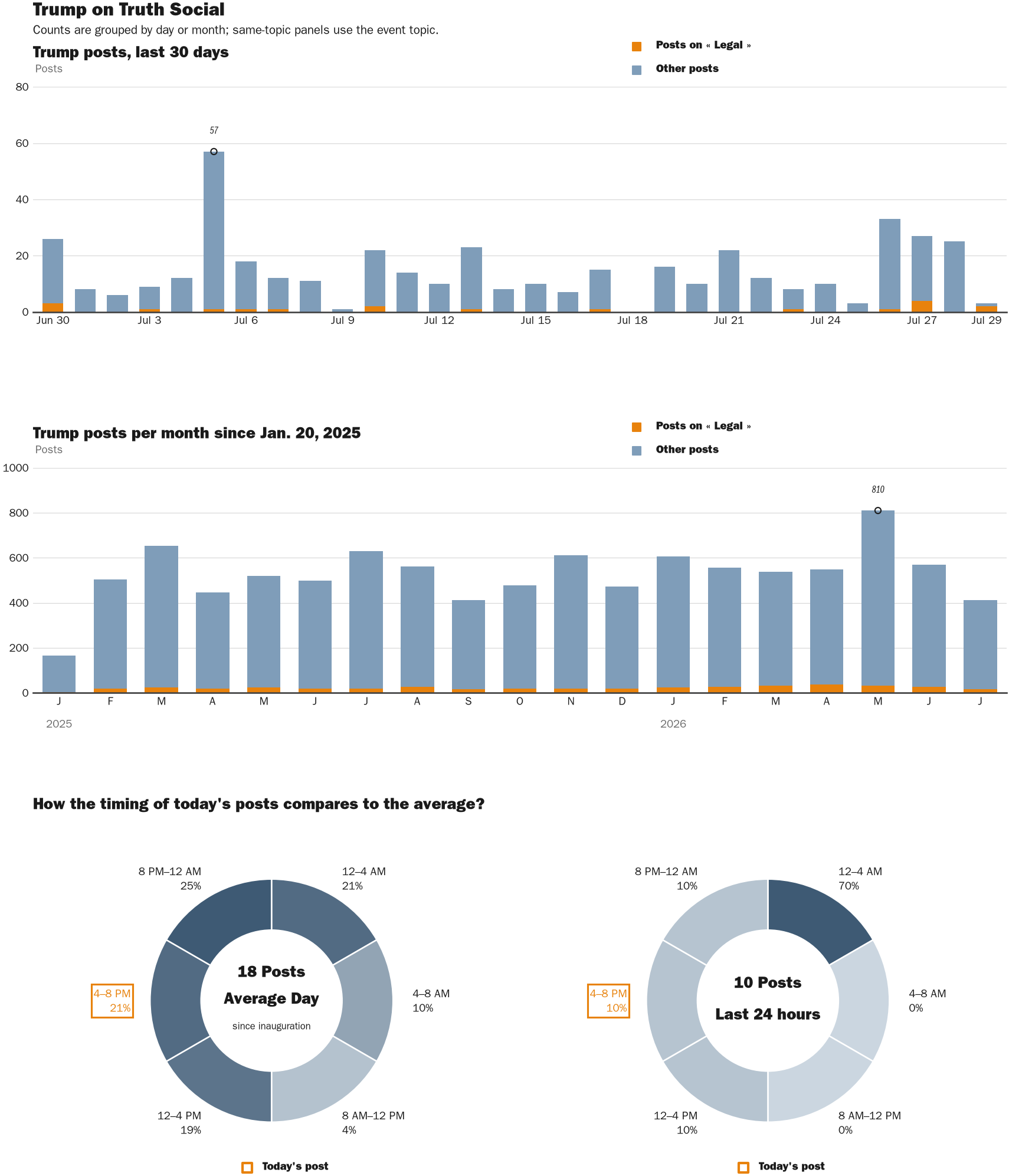
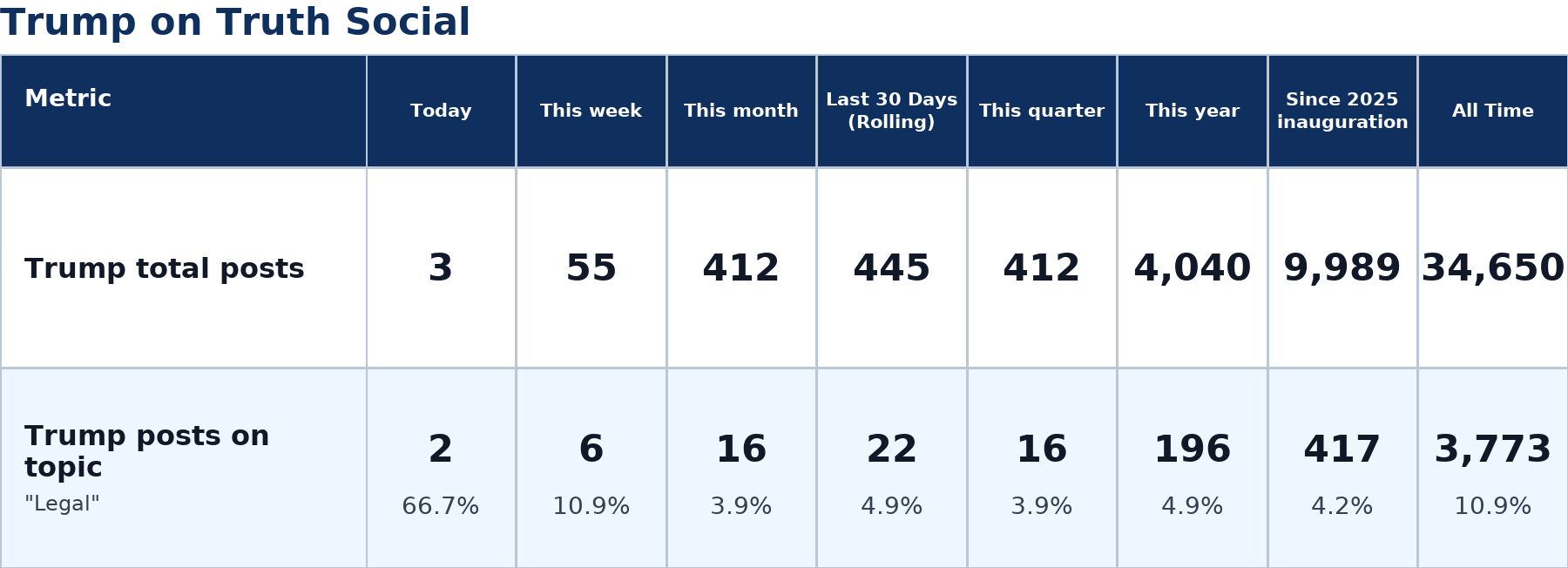
This is Trump’s 3rd message released on truthsocial today. On average, Trump produces 18 posts per day since his inauguration on January 20, 2025.
The move fits a broader pattern in Trump’s recent messaging, with 22 of his 445 posts over the last 30 days focused on the topic of Legal.
The stakes reach beyond rhetoric. A sitting president attacking the highest court over specific rulings sharpens a standoff between two branches of government, and the outcome shapes who pays for tariffs and who qualifies as a citizen. Importers and consumers bear tariff costs when duties survive, while families of noncitizens gain or lose legal footing depending on how courts read the Fourteenth Amendment.
Birthright citizenship rests on the Fourteenth Amendment, ratified in 1868, which grants citizenship to all persons born in the United States and subject to its jurisdiction. The Supreme Court affirmed that principle in United States v. Wong Kim Ark in 1898, ruling that a child born on American soil to noncitizen parents held citizenship. Any reversal or narrowing of that century-old precedent would mark a consequential shift in American constitutional law.
Tariffs carry their own long history of legal fights. Courts have repeatedly weighed how far a president may stretch statutory authority to impose duties without direct action by Congress, which holds the power to levy taxes and regulate commerce under Article I of the Constitution. Adverse rulings can force refunds to importers and unwind trade measures already priced into supply chains.
For the average American, the practical effect runs through prices and paperwork. Tariffs that survive court review raise the cost of imported goods, and businesses often pass those costs to shoppers at the register. Rulings on citizenship touch passports, benefits, and the legal status of newborns, reaching households far removed from any courtroom.
This has happened before. Presidents have long clashed with the Supreme Court over rulings they viewed as obstacles, and public criticism of the justices is a recurring feature of Trump’s tenure. The novelty lies in the scale of the claim, not the conflict itself.
The next decisions on these disputes rest with the federal courts, and ultimately the Supreme Court, which controls its own docket. A date for any further ruling on birthright citizenship or tariff authority has not been announced.
Presidential feuds with the judiciary run deep in American history, as happened before. Thomas Jefferson clashed with Chief Justice John Marshall after the 1803 decision in Marbury v. Madison, which established judicial review and cemented the court’s power to strike down laws. Franklin D. Roosevelt, frustrated by rulings that gutted New Deal programs, proposed in 1937 to expand the court to as many as 15 justices, a plan the Senate rejected by a 70 to 20 vote. Roosevelt lost the legislative battle yet outlasted the opposition, as retirements let him reshape the bench within four years.
Assigned topic: Legal.
This is Trump’s 3rd Truth Social post today, out of 3 total today.
On average, Trump produces 18 posts per day since his inauguration on January 20, 2025.
Trump’s last post was 5 hours ago.
This post is not part of a thread.

NewsFindr Chart Maker
Photo by Zenger real-time database of all Truth Social posts.
Zenger analysis
Photo by Zenger analysis