Trump Amplifies Johnson Push to Kill Senate Filibuster
Trump shares Wisconsin Sen. Ron Johnson's opinion piece urging Republicans to end the 60-vote threshold before Democrats regain power and do it first.

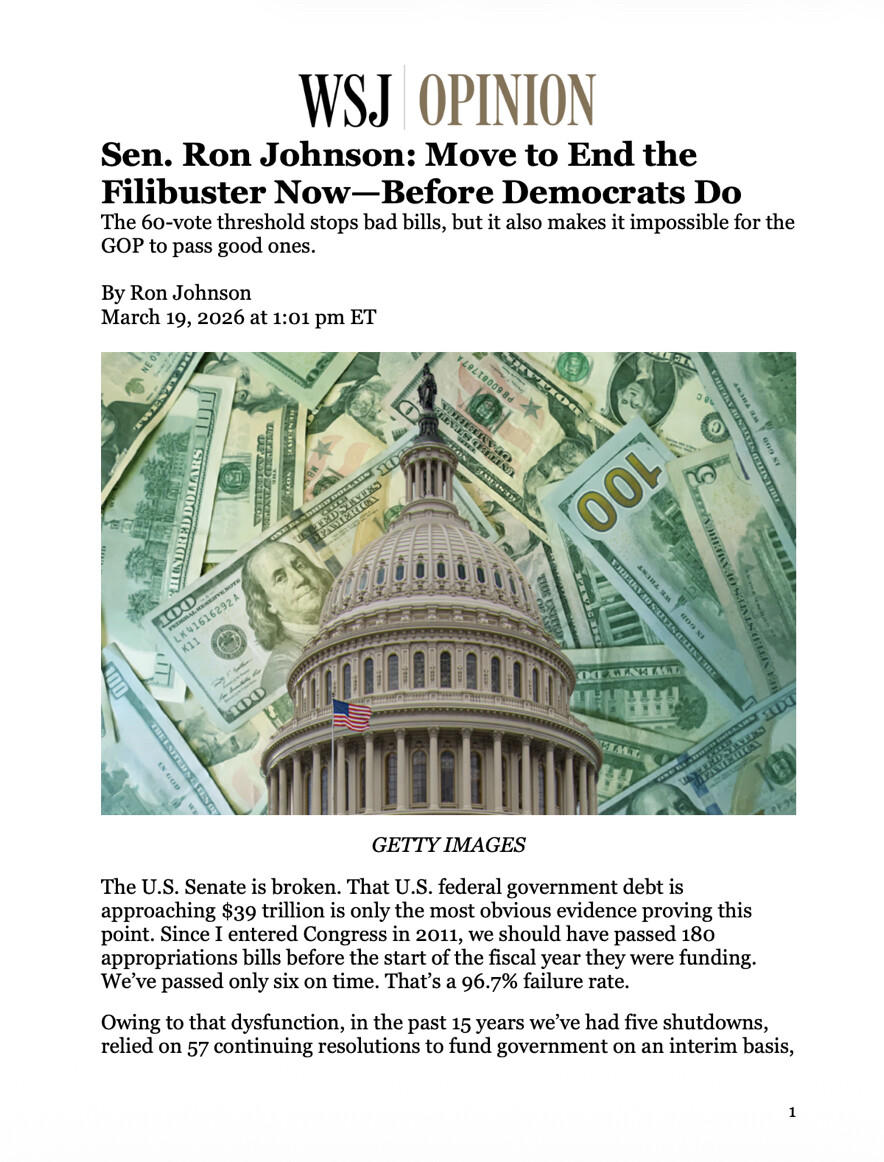
WASHINGTON D.C. — Donald J. Trump amplified a call to abolish the Senate filibuster, sharing an opinion piece by Wisconsin Republican Sen. Ron Johnson that argues Republicans should end the 60-vote rule before Democrats do.
The op-ed frames the Senate as dysfunctional, citing federal debt approaching $39 trillion and a 96.7% failure rate on passing appropriations bills on time since 2011. Johnson wrote that the chamber has weathered five shutdowns and leaned on 57 continuing resolutions over the past 15 years.
“By ending the filibuster now, Republicans could pass important legislation that the public overwhelmingly supports, but Democrats oppose,” Johnson wrote in the piece.
The filibuster requires 60 votes to advance most legislation in the 100-seat Senate, forcing bipartisan compromise or gridlock. Johnson argued that removing the threshold would let the majority govern, and that Democrats would scrap it the moment they hold power anyway.
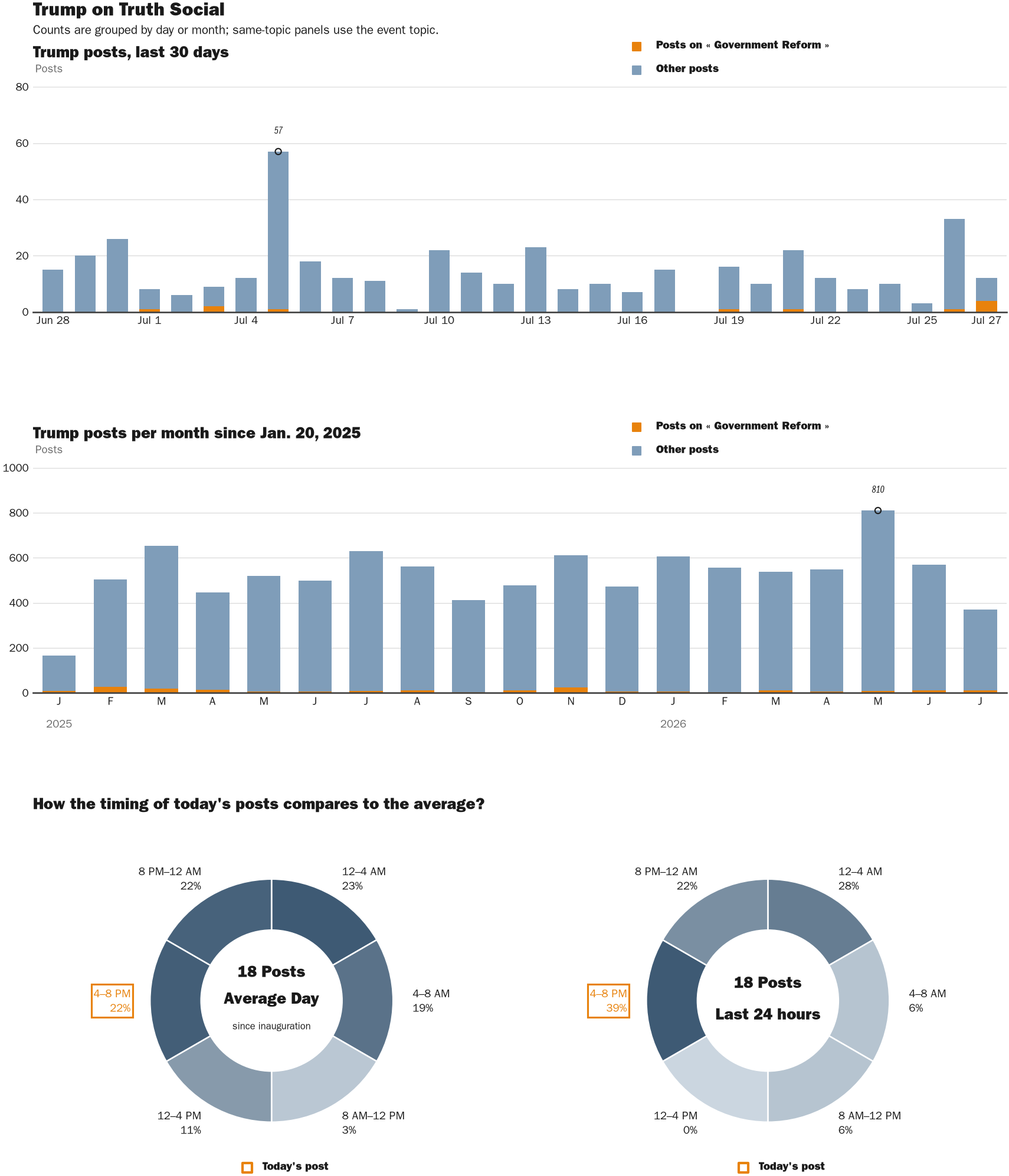
Here is the full post on truthsocial: “Sen. Ron Johnson: Move to End the Filibuster Now—Before Democrats Do: https://www.wsj.com/opinion/sen-ron-johnson-move-to-end-the-filibuster-nowbefore-democrats-do-4171ee4c” on July 27, 2026 at 4:24 PM ET.
Trump shared the article by mentioning the source (see wsj), which carries Johnson’s byline and a March 19, 2026 dateline.
Stakes run high for both parties. Ending the filibuster would let a bare majority pass sweeping bills, handing whichever party controls Washington near-total legislative reach. The change would strip the minority of its main tool to block or amend legislation. Johnson conceded the cost, writing that he would “hate to lose the ability to block awful Democrat legislation” but is “willing to acknowledge reality and beat Democrats to the punch before it’s too late.”
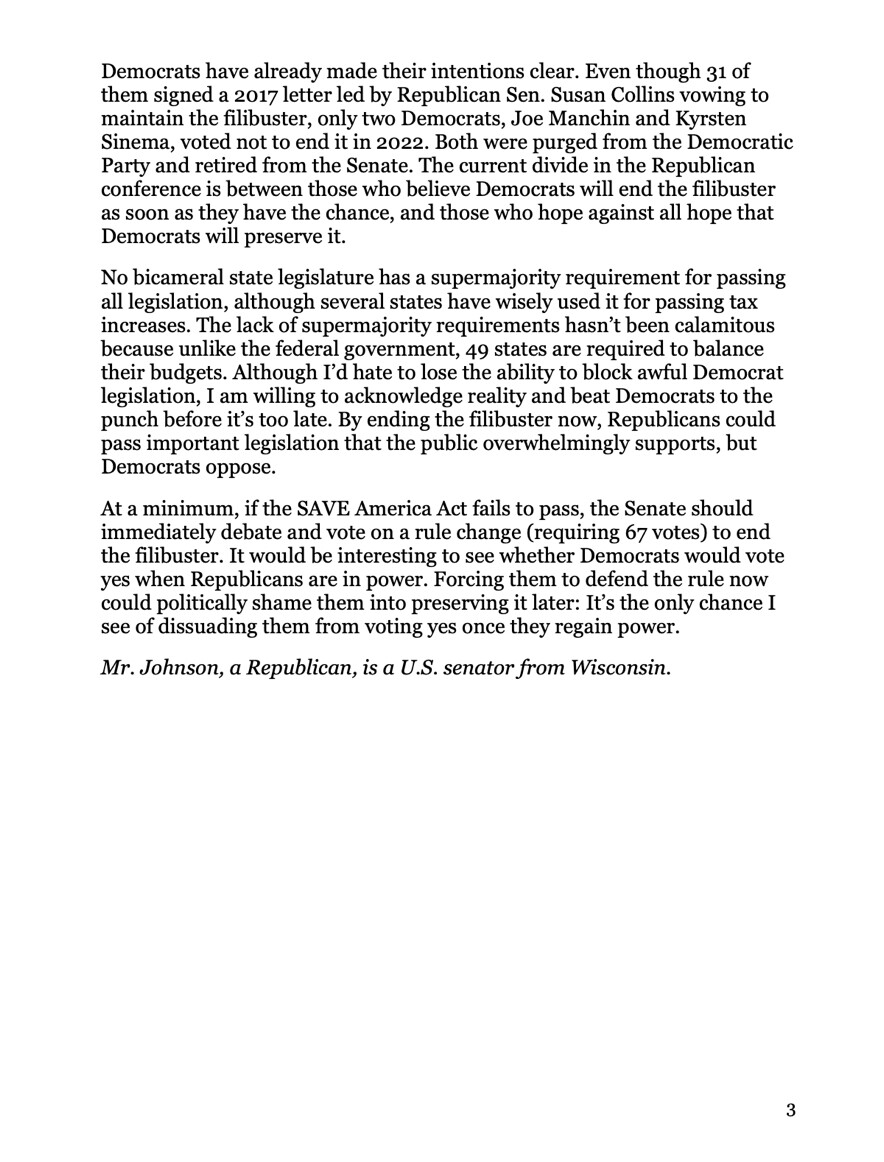

President Donald J. Trump shared an opinion piece by Sen.
© copyright Zenger.News
The fight over the rule is not new. Johnson noted that 31 Democrats signed a 2017 letter led by Maine Republican Sen. Susan Collins vowing to preserve the filibuster, yet only two Democrats, Joe Manchin and Kyrsten Sinema, voted against ending it in a 2022 push tied to voting-rights legislation. Both later left the Senate. The Senate previously curtailed the filibuster for nominations, eliminating it for most executive and judicial picks in 2013 and for Supreme Court nominees in 2017.
Johnson offered a comparison to the states, writing that no bicameral state legislature imposes a supermajority requirement for passing all legislation, though several use one for tax increases. He tied the difference to fiscal discipline, noting that 49 states must balance their budgets while the federal government does not.
For the average reader, a filibuster repeal would reshape how quickly federal policy swings between elections. Tax rates, health care, immigration, and spending priorities could shift sharply each time control of the Senate flips, ending the incremental pace that the 60-vote threshold has long enforced.
Calls to eliminate the filibuster have surfaced before. Members of both parties have floated the idea for decades, and each majority has weighed the trade-off between short-term wins and long-term exposure when the other side takes over.
The next move rests with the Senate leadership and its 100 members, who would need a simple majority to change the standing rule. No vote on ending the legislative filibuster has been scheduled, and a date for such a decision has not been announced.
The filibuster traces to a procedural gap that widened in the 19th century, when the Senate dropped a motion allowing a simple majority to cut off debate. In 1917, senators adopted Rule 22, letting two-thirds of the chamber invoke cloture, a threshold lowered to three-fifths, or 60 votes, in 1975. Southern senators famously used the tactic to stall civil-rights bills, and the record for a lone speech belongs to Sen. Strom Thurmond, who held the floor for 24 hours and 18 minutes in 1957. Each reformer who touched the rule found that the tool they weakened eventually served their opponents.
NewsFindr Chart Maker
Photo by Zenger real-time database of all Truth Social posts.