
Trump Warns GOP Senators Against Michigan Democrat’s Push to End Filibuster
Trump cautions Republican senators that Michigan Senate candidate Abdulrahman Mohamed El-Sayed's call to end the filibuster could reshape the Senate, the House and the Supreme Court.

WASHINGTON D.C. — Donald J. Trump warned Republican senators that a Michigan Democratic Senate candidate’s drive to abolish the legislative filibuster could hand Democrats lasting control of Washington.
Trump singled out Abdulrahman Mohamed El-Sayed, the Michigan Democratic Senate candidate and former Detroit health director, describing the end of the filibuster as El-Sayed’s signature campaign pledge. Trump claimed the change would let Democrats add four senators, eight House members, electoral and popular votes, and expand the Supreme Court to 23 justices.
Here is the full post on truthsocial: “For our Great Republican Senators, friends of mine “all,” please be advised that the Communist Dumocrat Senate Candidate from Michigan, Abdulrahman Mohamed El-Sayed, is touting, as perhaps his single most important point, the Termination of the Filibuster. I watched yesterday, and he’s gone Termination CRAZY. If he succeeds, the Dumocrats will gain 4 Senators, 8 Congressmen, many Electoral and Popular Votes, a stacked Supreme Court with 23 Justices, and I will be, sadly, despite the great job we are doing, the last Republican President! Trump” on August 6, 2026 at 4:06 PM ET.
This is Trump’s 8th message released today, and the last post was 3 hours ago, and it is not part of a thread. On average, Trump produces 18 posts per day since his inauguration on January 20, 2025. The move fits a broader pattern in Trump’s recent messaging, with 105 of his 430 posts over the last 30 days classified as elections posts.
The filibuster is a Senate procedure that requires 60 votes to end debate on most legislation. Ending it would let a simple majority pass bills, statehood measures and other priorities without minority support. Supporters of the change argue it would break gridlock. Opponents counter that it protects the minority party and forces compromise.
The stakes fall along familiar partisan lines. Republicans who hold a narrow majority would lose the tool they now use to block Democratic bills, while Democrats would gain a path to enact their agenda with a bare majority. Trump framed the outcome in personal terms, warning that he could be the last Republican president if the rule falls.
The Republican Party has long cast itself as a guardian of orderly constitutional government. The party’s 1912 platform reaffirmed its intention to uphold the authority and integrity of the courts and warned against altering constitutional provisions outside orderly fashion, according to teachingamericanhistory.org. That tradition of institutional caution has shaped Republican rhetoric on Senate rules for more than a century, according to riponsociety.org.
For the average reader, a change to the filibuster would alter how quickly federal laws move. Legislation on taxes, health care and voting could pass with fewer votes, meaning shifts in policy could arrive faster after each election, with less need for cross-party deals.
This has happened before in narrower forms. The Senate eliminated the filibuster for most executive and judicial nominations in 2013, then extended that change to Supreme Court nominees in 2017. Both moves lowered the threshold for those confirmations to a simple majority, reshaping how justices reach the bench.
The next decision rests with Michigan voters, who will choose their Senate nominee and general election winner during the 2026 election cycle. A specific date for any Senate vote on the filibuster itself has not been announced.
Disputes over Senate rules are not new to the chamber’s history. The formal filibuster grew out of an 1806 rule change that removed the Senate’s ability to cut off debate by simple motion. For more than a century the chamber had no way to force a vote, until senators adopted the cloture rule in 1917 requiring a two-thirds majority to end debate. Lawmakers lowered that bar to three-fifths, or 60 votes, in 1975. Each reform expanded the majority’s power at the expense of the minority, and every leader who pushed for change reshaped the institution that later constrained his own successors.
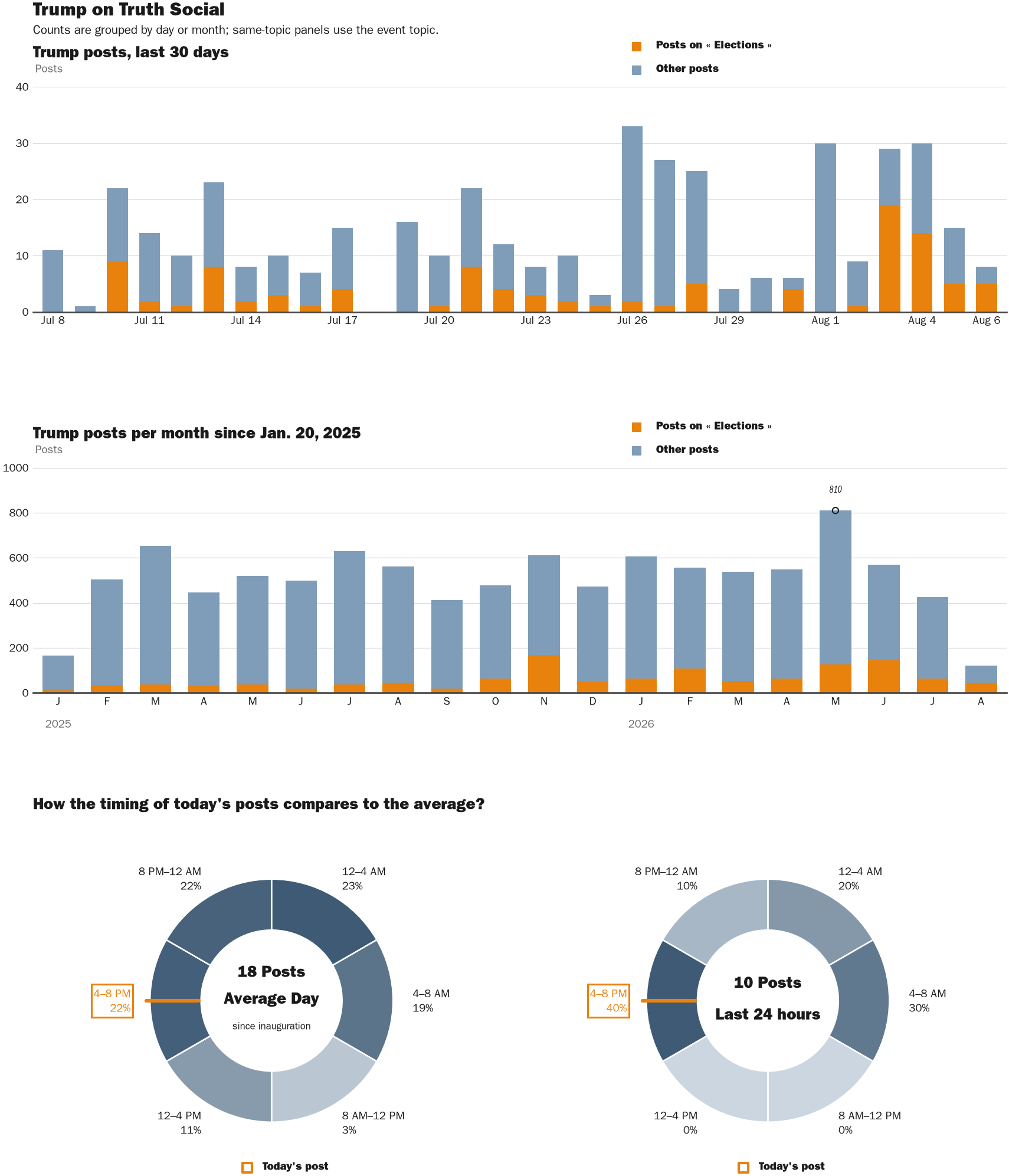

NewsFindr Chart Maker
Photo by Zenger real-time database of all Truth Social posts.
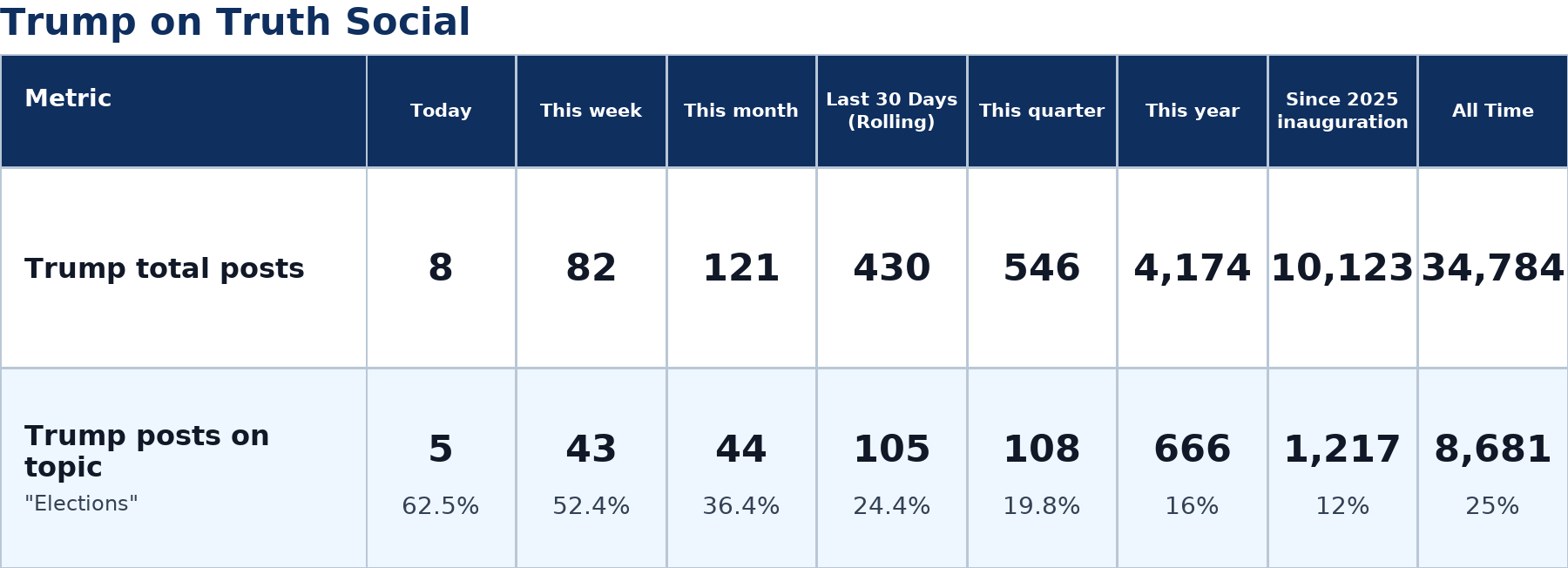
Zenger analysis
Photo by Zenger analysis