
Air Force Triples Protagonist Technology Contract to $20.5 Million
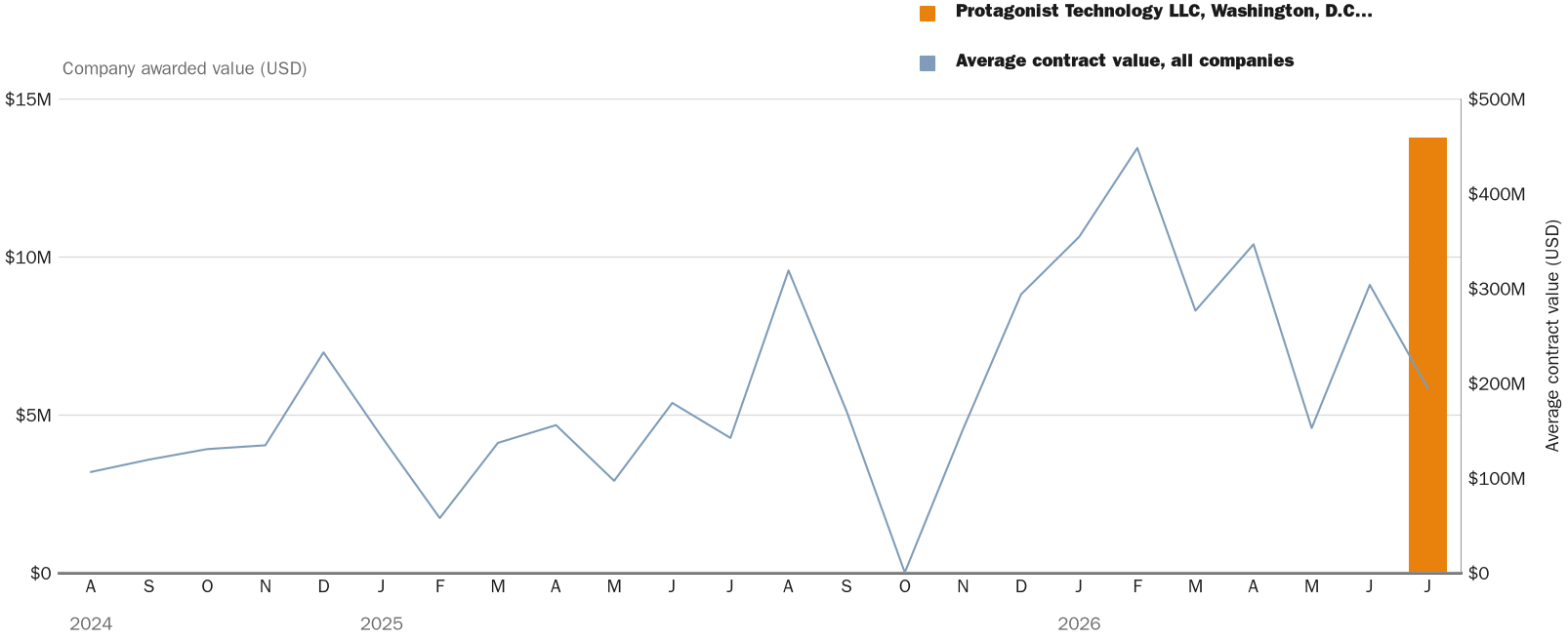
The Washington, D.C., firm won a $13.8 million sole-source modification for Small Business Innovation Research Phase III work, with completion expected by Feb. 17, 2030.

Protagonist Technology LLC, a Washington, D.C., research firm, won a $13.8 million U.S. Air Force contract modification that tripled the deal’s value, as announced on war.gov.
The modification, designated P00004, lifts the cumulative face value of firm-fixed-price contract FA8802-26-C-0003 to $20.5 million from $6.7 million, according to war.gov. Fiscal 2025 research, development, test and evaluation funds covering the full $13.8 million were obligated at the time of the award. Work will run through Feb. 17, 2030.
The award funds Small Business Innovation Research Phase III support, the commercialization stage of a federal program that helps small firms move early-stage research toward government or market use, according to war.gov. Phase III work carries technology developed under earlier phases into deployable products or services. The Air Force issued the deal as a sole-source acquisition, meaning no competitive bidding preceded it.
The Enterprise Sourcing Division at Los Angeles Air Force Base, California, serves as the contracting activity, according to war.gov. All performance will take place in Washington, D.C. The Air Force awarded the modification on July 28, 2026, and the war department published it the following day.
Sole-source awards concentrate benefit on a single vendor, and Protagonist Technology gains guaranteed funding through the end of the decade. Taxpayers absorb the cost, and rival small firms lose a chance to compete for the same work. The Small Business Innovation Research program allows agencies to skip competition for Phase III when the effort derives from earlier funded research, a structure that rewards incumbents who cleared the program’s first two stages.
Small Business Innovation Research contracts remain modest against the Pentagon’s largest procurements, which run into the billions. A $20.5 million cumulative value places this deal among thousands of smaller research awards the military issues each year rather than among flagship weapons programs. The tripling of the contract’s value nonetheless signals expanded confidence in the underlying technology.
The program touches ordinary readers indirectly. Federal research dollars routed to small firms have seeded technologies that later reached commercial markets, and the taxpayer funds obligated here support work the Air Force expects to use through 2030.
Sole-source Phase III modifications happen regularly. The Small Business Innovation Research statute authorizes agencies to award Phase III work without renewed competition when it flows from a prior phase, so contract expansions like this one recur across the military services. The mechanism exists precisely to let successful research projects scale.
The Enterprise Sourcing Division at Los Angeles Air Force Base will manage the contract’s next steps and any further modifications. No date for additional action has been announced, though the current performance period extends to Feb. 17, 2030.
Small business set-asides in federal procurement trace back decades. Congress created the Small Business Innovation Research program in 1982 under the Small Business Innovation Development Act, requiring agencies with large research budgets to reserve a share for small firms. Lawmakers have reauthorized the program repeatedly since, most recently extending it through the 2020s. Firms that advanced to Phase III, the commercialization stage, have grown from garage operations into established defense suppliers on the strength of such awards.

NewsFindr Chart Maker
Photo by NewsFindr Chart Maker