Trump Presses Senate to Pass Budget Resolution Before August Recess
Trump thanks House Republicans for advancing a budget measure and urges the Senate to adopt a resolution by simple majority before lawmakers leave Washington.

WASHINGTON D.C. — Donald J. Trump urged the Senate to adopt a budget resolution by simple majority before the August recess, praising House Republicans for advancing what he called one of the most consequential bills in the nation’s history.
The appeal centered on a measure Trump said would strengthen the military, provide aid for farmers and carry as much of the Save America Act as possible, according to his post on truthsocial. He framed the House vote as a first step and called for the Senate to move quickly.
Here is the full post on truthsocial: “Thank you to all the Senators who opposed yet another Dumocrat-led attempt to undermine our National Security. Congratulations to our GREAT Speaker, Mike Johnson, and the House Republicans for their MAJOR success in taking the first step towards passing the Budget Bill. Thank you to our terrific Chairman, Jodey Arrington, Chip Roy, Michelle Fishbach, Virginia Foxx, Jason Smith, Mike Rogers, GT Thompson, Bryan Steil, our incredible Whip, Tom Emmer, Majority Leader, Steve Scalise, and all those who came together to take this important step. This will be one of the most consequential Bills in America’s History. Strengthening our powerful Military, providing aid for our Farmers and, most importantly, as much of THE SAVE AMERICA ACT as possible. Our Voters will be extremely happy — And even impressed! I am asking that the Senate adopt a Budget Resolution, which can pass with a simple Majority, before leaving for the August recess. We are ready to work side-by-side with the Senate to get this done for the American People! Trump” on July 24, 2026 at 1:32 PM ET.
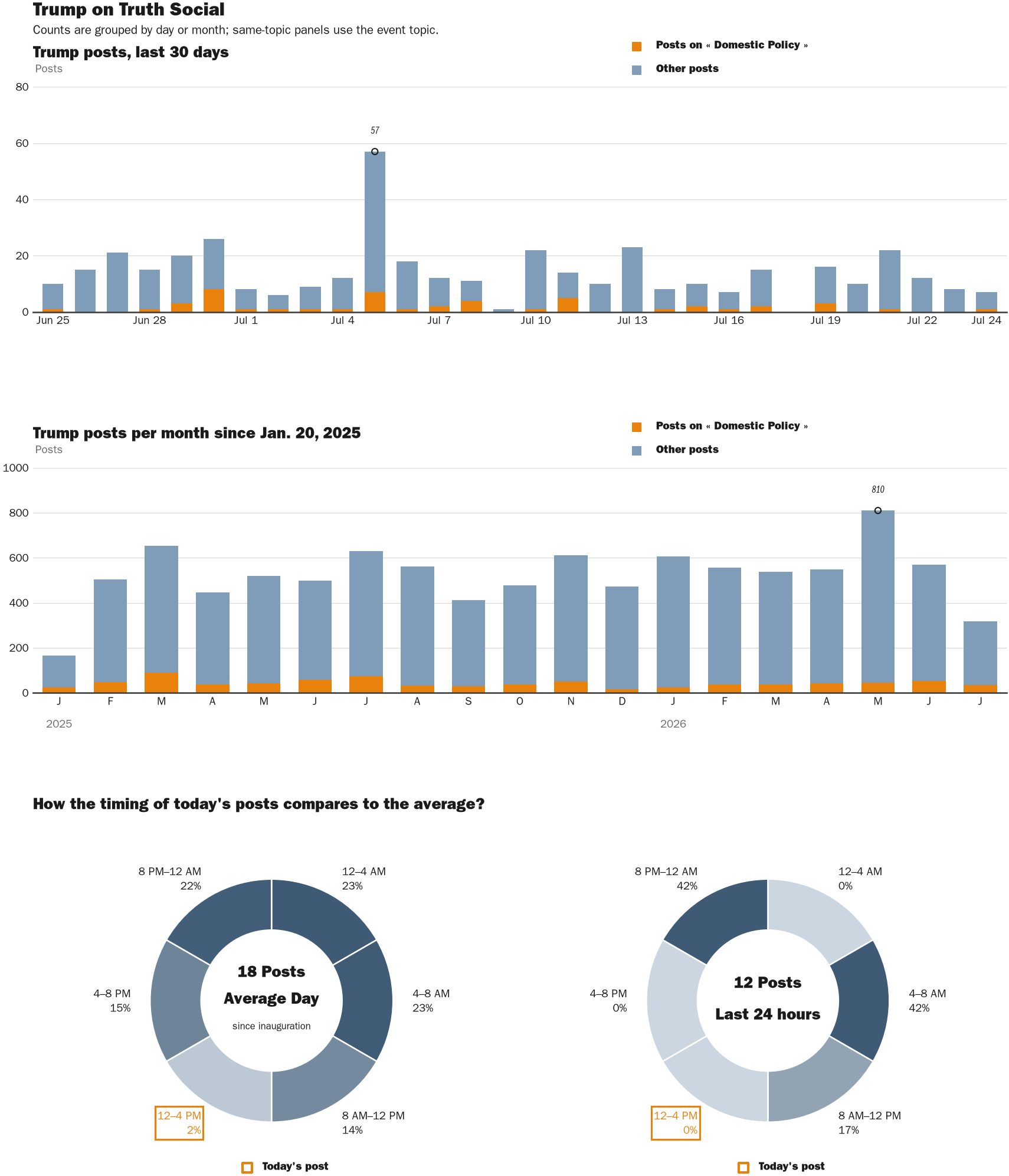
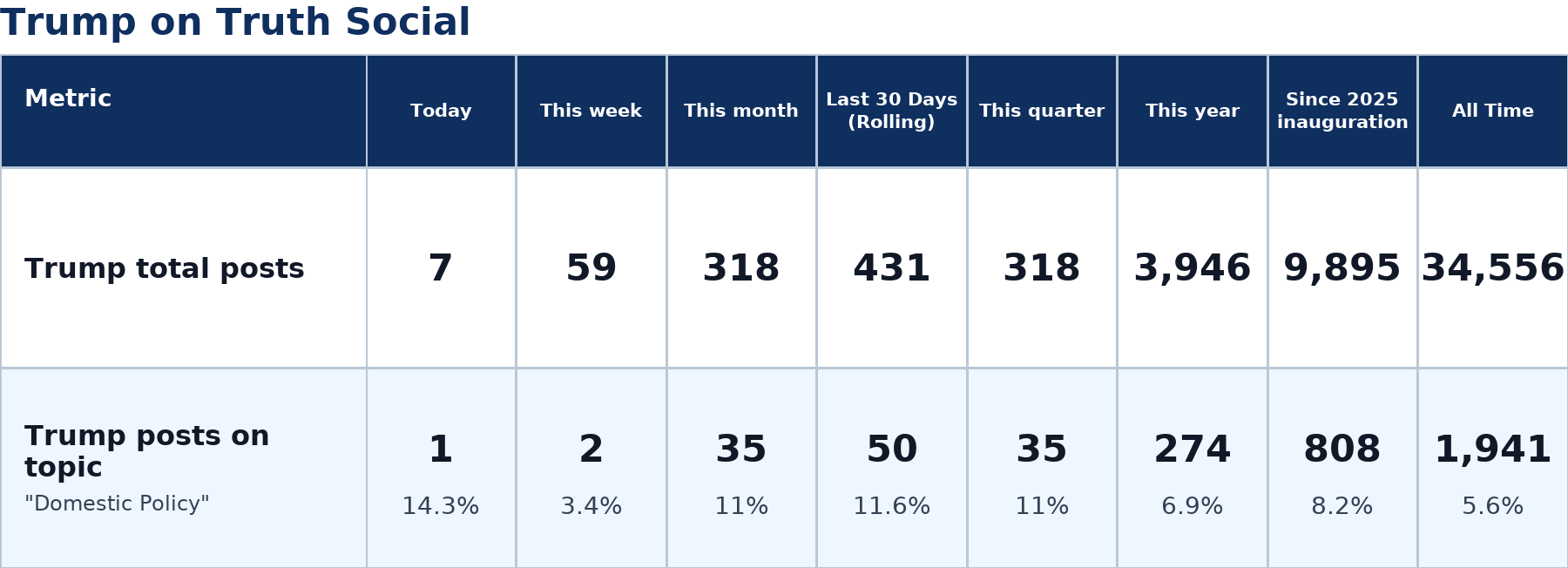
This is the first message released by Trump today. On average, Trump produces about 12 posts per day since his inauguration on January 20, 2025.
The post fits a broader pattern in Trump’s recent messaging, with 50 of his 431 posts over the last 30 days focused on domestic policy.
Trump named a roster of House Republicans in the post, including Speaker Mike Johnson, Budget Committee Chairman Jodey Arrington, Whip Tom Emmer and Majority Leader Steve Scalise. He credited them with the initial procedural win. He then asked the Senate to follow with a resolution that avoids the 60-vote threshold most legislation faces.
The budget resolution unlocks reconciliation, a process that lets the majority party pass fiscal legislation with 51 votes and sidestep a filibuster, according to senate.gov. That path matters because Republicans hold a narrow chamber and cannot count on opposition support for a sweeping spending and tax package.
The stakes fall heaviest on the priorities Trump listed. Defense contractors and the armed services stand to gain from higher military outlays, while farm-state producers would benefit from added agricultural aid. Taxpayers and program beneficiaries face the offsetting question of how the package is financed, a fight that typically dominates reconciliation debates.
Budget standoffs have shaped Washington for decades. The most recent extended lapse came during the 2018 to 2019 partial government shutdown, which ran 35 days and stands as the longest in United States history, according to crsreports.congress.gov. That episode showed how quickly spending disputes can stall federal operations when the chambers and parties diverge.
For the average reader, the outcome touches paychecks and services. A reconciliation bill can adjust tax rates, farm supports and Pentagon spending, decisions that ripple into food prices, defense jobs and the federal deficit that every household ultimately shares.
This has happened before. Trump used the reconciliation route in his first term to pass the 2017 tax overhaul with a simple majority. Both parties have leaned on the tool for signature fiscal laws when they lacked 60 votes.
The next move belongs to the Senate, which Trump asked to adopt the resolution before the August recess. A specific floor date for that vote has not been announced.
Reconciliation has decided the fate of major spending laws before, as budget fights repeatedly tested past presidents. Congress created the process in the Congressional Budget Act of 1974, and lawmakers first used it in 1980 under President Jimmy Carter, according to britannica.com. Carter signed that reconciliation package, yet the deficit-cutting effort did little to reverse the economic strain that helped cost him reelection later that year.

NewsFindr Chart Maker
Photo by Zenger real-time database of all Truth Social posts.
Zenger analysis
Photo by Zenger analysis

OpenTopoMap / Natural Earth – Michelle Fishbach, Virginia
Photo by OpenTopoMap / Natural Earth – Michelle Fishbach, Virginia