
Teledyne FLIR Awarded $44.5 Million Army Deal to Sustain Battlefield Robots
The Chelmsford, Massachusetts, firm received a firm-fixed-price and cost-plus-fixed-fee contract to maintain software for the Man Transportable Robotic System Increment II through 2031, the Army said.

CHELMSFORD, MASSACHUSETTS — Teledyne FLIR Unmanned Ground Systems Inc., a Chelmsford, Massachusetts, maker of battlefield robots and infrared sensors, received a $44.5 million Army contract to keep its ground-robot software running for five more years, as announced on war.gov.
The award is a firm-fixed-price, cost-plus-fixed-fee, indefinite-delivery/indefinite-quantity contract for post-production software sustainment of the Man Transportable Robotic System Increment II. It covers software maintenance, engineering support and technical support across the system lifecycle. The estimated completion date is August 6, 2031. The Army solicited bids via the internet and received one, a detail that signals Teledyne FLIR was effectively the sole competitor for work tied to a platform it already builds.
The Man Transportable Robotic System is a portable ground robot that soldiers deploy to inspect threats and handle explosive ordnance from a safe distance. Teledyne FLIR’s ground platforms range from the 1.2-ounce Black Hornet nano-drone to the 500-pound Kobra robot, and the company supplies imaging sensors and unmanned systems across the U.S. military and more than 50 countries, according to teledyne.com. The systems aim to enhance operator survivability and situational awareness while keeping troops out of harm’s way, according to Google.
Sustainment contracts like this one carry outsized weight for the winner and for the taxpayer. The Army locks in a single vendor to service equipment already in the field, which secures years of predictable revenue for Teledyne FLIR and reduces the risk that fielded robots go dark for lack of updates. The tradeoff is limited competition, since only the original manufacturer holds the code and engineering knowledge to keep the machines current.
Unmanned ground systems moved from novelty to necessity over two decades of U.S. combat operations. Bomb-disposal robots deployed in Iraq and Afghanistan to defuse improvised explosive devices, and the Army has since standardized on modular platforms it can upgrade rather than replace. Teledyne Technologies expanded its footprint in this market through its acquisition of FLIR Systems, which broadened its robotic portfolio across air, ground and sea domains, according to teledyne.com.
For the average U.S. reader, the deal shows how defense spending increasingly flows into software upkeep rather than new hardware. A robot bought years ago now generates recurring maintenance work, much as a smartphone depends on continuous updates to stay useful.
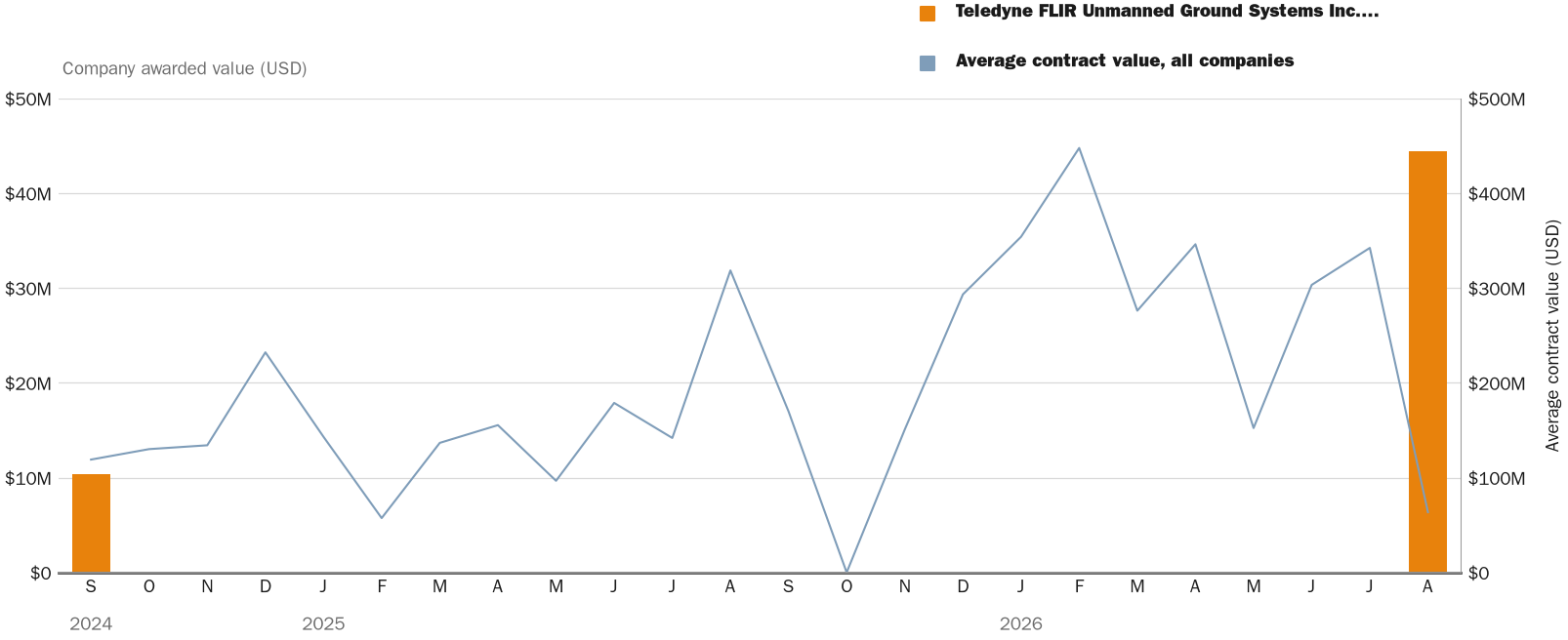
The award marks the first contract recorded for Teledyne FLIR Unmanned Ground Systems Inc.in 2026, and it stands as the fourth Department of Defense contract awarded in Massachusetts this year, according to war.gov. The value sits between the 2026 Army portfolio’s low of $9.1 million and its high of $53.9 billion. It was one of only two Department of Defense contracts issued nationwide on August 6, 2026.
The Army has funded long-term sustainment of its robotic fleet before. Modular open-systems designs were adopted specifically to allow such software refreshes over a machine’s life, according to teledyne.com.
Army Contracting Command at Detroit Arsenal, Michigan, will direct the work and set funding with each order under contract number W912CH-26-D-A106. A date for the first delivery order has not been announced.
The robot on the battlefield has a longer lineage than most soldiers realize. The U.S. military first fielded remote-controlled ground vehicles in earnest during the Cold War, and by the 2000s bomb-disposal robots such as the PackBot had become fixtures of combat engineering units, with thousands deployed to clear roadside explosives in Iraq. Teledyne FLIR’s predecessor lines grew directly out of that demand for machines that could take the blast so a person did not have to. The lesson from that era proved durable, as the contractors who kept those early robots running became the incumbents who win the sustainment work that follows.
This contract represents the 1st contract awarded to Teledyne FLIR Unmanned Ground Systems Inc., in 2026, bringing the company’s total contract value for the year to $44,459,699. It is also the 4th Department of Defense contract awarded in Massachusetts during 2026. Because this is the first award to Teledyne FLIR Unmanned Ground Systems Inc. recorded in the database, it establishes the company’s initial benchmark within the Army portfolio. Specifically, it falls between the 2026 Army portfolio’s year-to-date minimum of $9,051,490 and maximum of $53,859,843,289. Overall, this award was announced among 2 Department of Defense contracts issued nationwide on August 6, 2026.

NewsFindr Chart Maker
Photo by NewsFindr Chart Maker
Protomaps / Natural Earth – Chelmsford, Massachusetts
Photo by Protomaps / Natural Earth – Chelmsford, Massachusetts