Trump Posts Image as Truth Social’s Truth API Draws Legal Fire
Trump shares an image on Truth Social the same day his media company launches a premium feed that securities experts warn could run afoul of insider trading law.

WASHINGTON D.C. — Donald J. Trump shared an image on Truth Social as his media company launched a paid service selling early access to his market-moving posts.
The post arrived on the same day Trump Media & Technology Group C orp., the company behind the truthsocial platform, opened Truth API to trading firms according to wusf.org. The service delivers the president’s often market-moving announcements to institutional investors before the rest of the world, for a fee reported as high as $100,000 a month according to wusf.org.
“It’s insane,” said one Wall Street executive, who requested anonymity for fear of retaliation from the Trump administration, in remarks to NPR. “I can say for myself and 200 of my friends in finance, we’re not getting anywhere near this. In another administration, this would be considered criminal.”
The image-only post lands as regulators, lawmakers and securities lawyers weigh whether selling a head start on presidential posts crosses a legal line. That question reaches every ordinary investor who trades in U.S. markets.
Here is the full post on truthsocial: “truthsocial post containing one image.” on August 1, 2026 at 2:09 PM ET.
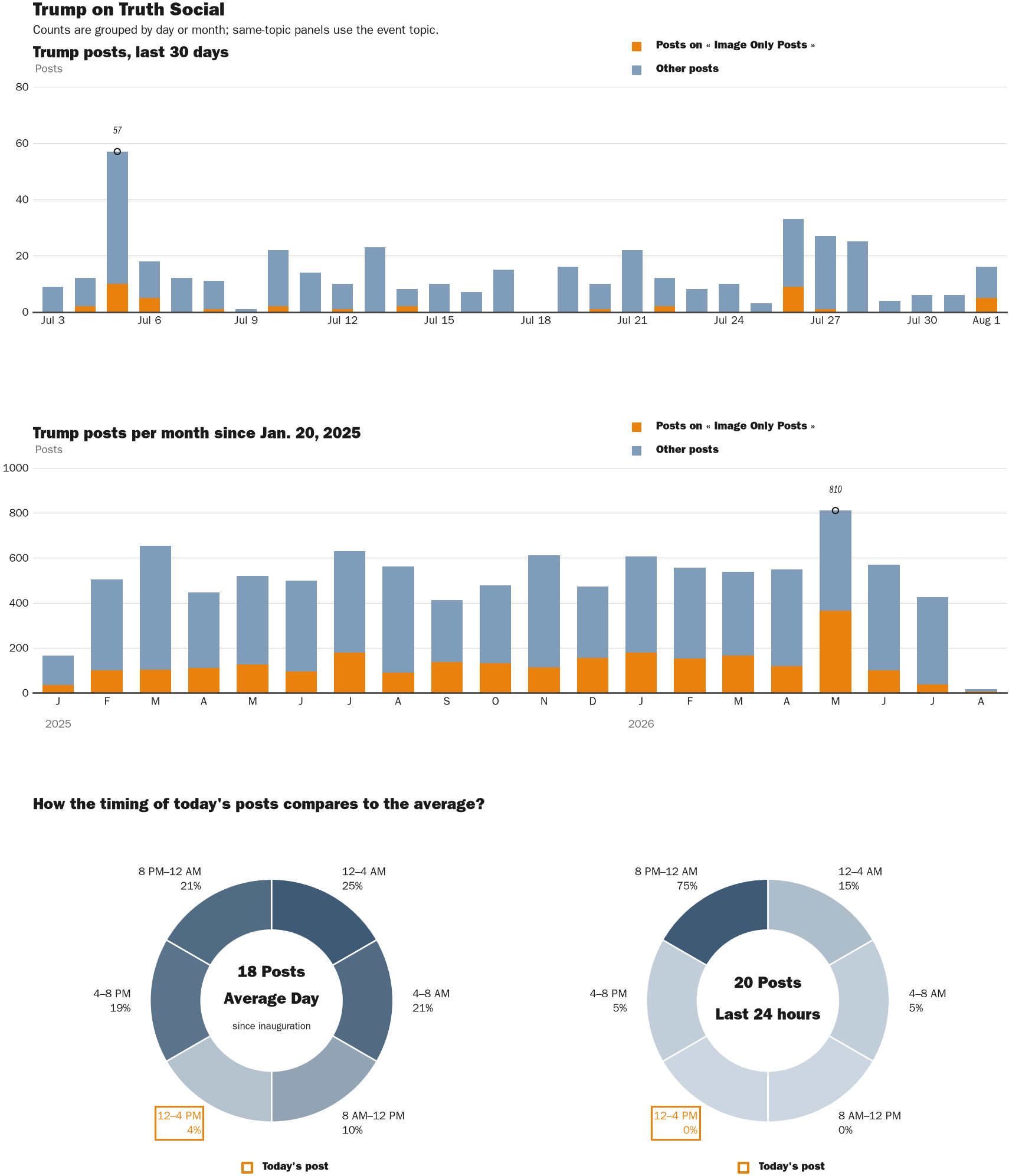
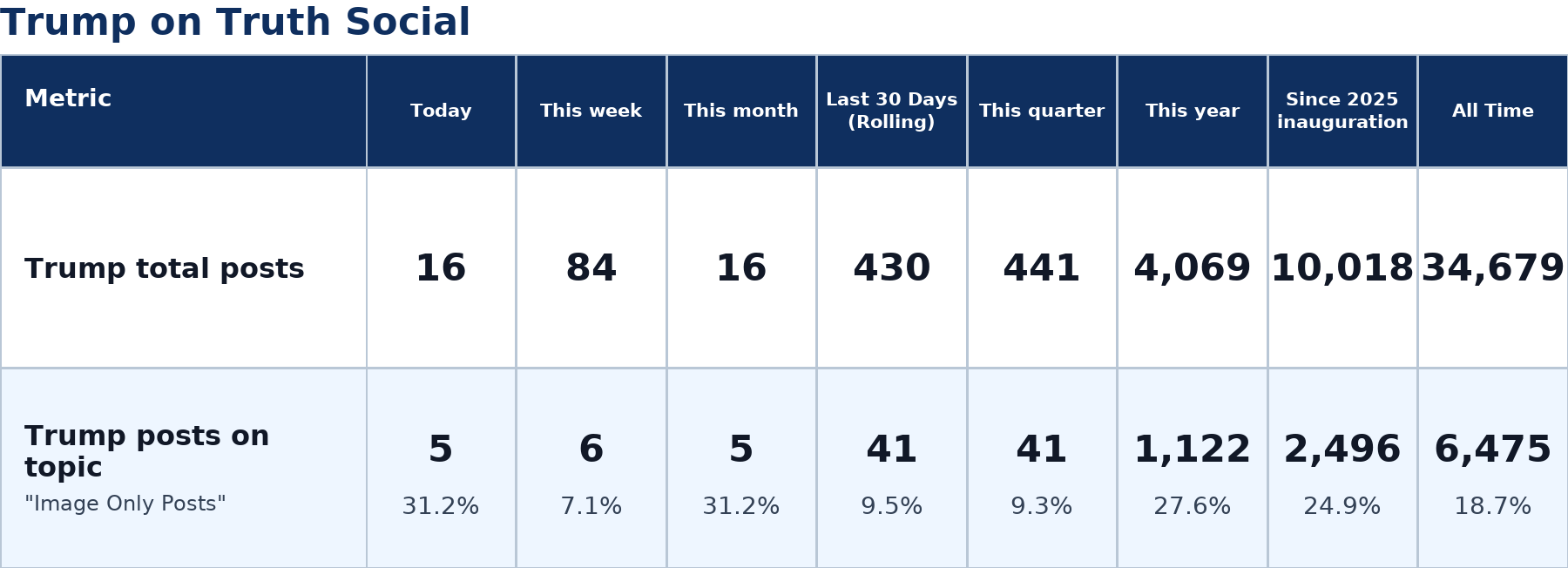
This is Trump’s 16th message released today. On average, Trump produces 18 posts per day since his inauguration on January 20, 2025.
The move fits a broader pattern in Trump’s recent messaging, with 41 of his 430 posts over the last 30 days classified as image-only posts.
Truth API launched Saturday and gives paying customers the fastest way to ingest truthsocial data, the company said. Such an offering hands institutional investors an edge in high-frequency trading, where an advantage of a few milliseconds can mean the difference of millions of dollars according to wusf.org. Trump’s posts often move markets, particularly as he turns to social media to break news about the Iran war and tariffs according to forbes.com.
The stakes fall hardest on retail investors and the president’s own family. Trump is the largest shareholder of his media company through a trust controlled by his eldest son, Trump Jr., regulatory filings show. The Trump family’s wealth grows as customers sign up according to wusf.org. Everyday traders stand on the other side of the ledger, potentially losing on trades because they lack the same access, former SEC lawyer Virginia Canter said according to wusf.org.
The legal history is unsettled. Renée Jones, a Boston College professor and former top SEC official, said the paid offering appears to run afoul of insider trading laws and pointed to the 2012 Stock Act, which bars the president from trading on privileged information according to wusf.org. Trump Media spokeswoman Shannon Devine rejected that reading, calling Truth API a way to ingest publicly available data and dismissing the criticism as an invented theory of insider trading according to wusf.org.
For the average American, the dispute touches confidence in the fairness of the markets that hold their retirement savings. When a handful of firms can see policy signals seconds early, ordinary savers trade at a structural disadvantage.
This has happened before in the sense that Trump has long blurred business and office. Trump Media lost $712 million in 2025 and generated just $3.7 million in advertising revenue, yet the stock has rallied roughly 48% since an all-time low below $7 in June according to forbes.com. The company debuted on the Nasdaq at $70.90 per share in 2024 according to forbes.com.
The next move belongs to the Securities and Exchange Commission. Democratic Senators Elizabeth Warren of Massachusetts and Adam Schiff of California asked the agency Wednesday to investigate, and the SEC declined to comment according to wusf.org. A date for any decision has not been announced.
Monetizing proximity to power isn’t the first time a sitting figure has faced the charge. The 2012 Stock Act itself grew out of reporting that lawmakers traded on nonpublic briefings during the 2008 financial crisis. Congress passed the measure by wide margins, and President Barack Obama signed it into law in April 2012. That statute, born to curb insider advantages inside government, now frames the case against the very office it was written to bind.
Assigned topic: Image Only Posts.
This is Trump’s 16th Truth Social post today, out of 16 total today.
On average, Trump produces 18 posts per day since his inauguration on January 20, 2025.
Trump’s last post was 4 minutes ago.
This post is not part of a thread.

NewsFindr Chart Maker
Photo by Zenger real-time database of all Truth Social posts.
Zenger analysis
Photo by Zenger analysis

OpenTopoMap / Natural Earth – Iran
Photo by OpenTopoMap / Natural Earth – Iran