Trump Touts StarForge Fab, Palantir Border Deal and $8 Billion Lockheed Contract
Trump says StarForge Industries will build an Arizona semiconductor plant creating 10,000 jobs while Palantir expands border AI and Lockheed Martin wins an $8 billion stealth fighter award.

WASHINGTON D.C. — Donald J. Trump said StarForge Industries will build a semiconductor plant in Arizona that he claimed would create 10,000 jobs, part of a wave of manufacturing and defense deals he announced.
Trump paired the chip project with an expansion of border-security artificial intelligence by Palantir Technologies Inc. Class A, the Denver-based data-analytics firm, and an $8 billion contract for Lockheed Martin Corporation, the largest U.S. defense contractor by sales, to build next-generation stealth fighters.
“Just signed a TREMENDOUS deal! StarForge Industries will build a new semiconductor fab in Arizona — 10,000 jobs!Palantir Technologies Inc. Class A is expanding their AI platform for border security. Also,Lockheed Martin Corporation awarded $8 billion contract for next-gen stealth fighters. America is BUILDING again!” Trump said, in a post on truthsocial.
Here is the full post on truthsocial: “Just signed a TREMENDOUS deal! StarForge Industries will build a new semiconductor fab in Arizona — 10,000 jobs!Palantir Technologies Inc. Class A is expanding their AI platform for border security. Also,Lockheed Martin Corporation awarded $8 billion contract for next-gen stealth fighters. America is BUILDING again!” on July 24, 2026 at 4:00 PM ET.
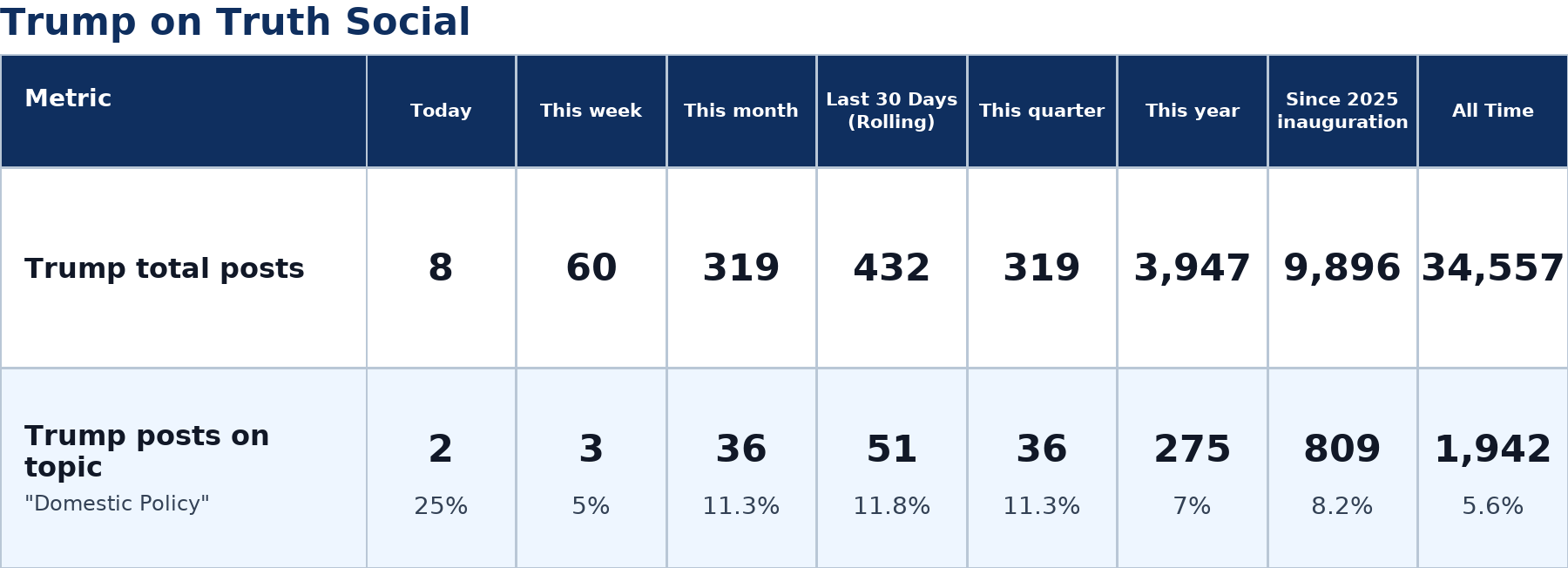
This is the first message released by Trump today. On average, Trump produces about 14 posts per day since his inauguration on January 20, 2025.
The move fits a broader pattern in Trump’s recent messaging. In the last 30 days, 51 of 432 Trump posts were on the topic “Domestic Policy” according to Zenger analysis.
The announcement bundles three separate threads of federal industrial policy into one message. Semiconductor manufacturing, surveillance software and combat aircraft each carry different budgets, timelines and oversight paths. Chip fabrication plants take years to build and rely heavily on skilled labor and imported equipment. Defense contracts of this size typically move through competitive procurement and congressional review before final award.
The stakes fall on workers, taxpayers and the companies named. Arizona would gain construction and manufacturing employment if the StarForge plant proceeds as described. Taxpayers would carry the cost of the Lockheed Martin Corporation Martin award, while contractors and their suppliers would share the revenue. Border-security contractors and privacy advocates alike watch expansions of AI surveillance tools, which draw scrutiny over data collection and civil liberties.
Arizona has become a national hub for chip production over the past several years, drawing multibillion-dollar commitments backed by federal incentives. A single 10,000-job plant would rank among the larger announced facilities in the state, though similar projected job figures have historically shifted as construction unfolds and phases stretch across years.
For the average U.S. reader, the deals touch prices, jobs and taxes. More domestic chip capacity could ease supply shortages that have raised costs for cars and electronics. Defense spending flows through federal budgets funded by taxpayers.
This has happened before. Trump has repeatedly used social media to spotlight corporate investment and defense awards, often before contracts are finalized or independently confirmed. Details on the terms, the timelines and the participating agencies were not provided in the post.
The next word on these projects rests with the companies and federal agencies involved, which would confirm contract terms, funding and build schedules. A date for any formal announcement or filing has not been announced.
Big-ticket manufacturing pledges tied to political messaging have surfaced before. In 2017, Foxconn announced a $10 billion display plant in Wisconsin projected to create 13,000 jobs, a deal celebrated at a White House ceremony. The project was repeatedly scaled back over the following years, and the promised employment never fully materialized, leaving state officials to renegotiate incentives worth billions of dollars.

Zenger analysis
Photo by Zenger analysis